




Vol. 27 - Num. 108
Original Papers
Comparative study of retrocochlear function in children aged 5 to 9 years born full-term: small versus appropriate for gestational age
Dourivaldo Silva Santos a, Luciene da Cruz Fernandesb, Mara Renata Rissatto Lagoc, Noemi Vieira de Freitas Riosd, Crésio de Aragão Dantas Alvese, Ana Caline Nóbrega da Costaf
aEstudiante de doctorado. Instituto de Ciencias de la Salud. Universidad Federal de Bahía. Salvador. Bahía. Brasil.
bDoctora en Medicina y Salud Pública. Profesora. Instituto Multidisciplinario de Rehabilitación. Universidad Federal de Bahía. Salvador. Bahía. Brasil.
cDoctora en Medicina y Salud Pública. Profesora. Departamento de Ciencias de la Vida. Universidad Estatal de Bahía. Salvador. Bahía. Brasil.
dDoctora en Medicina y Salud. Profesora. Departamento de Ciencias de la Vida. Universidad Estatal de Bahía. Salvador. Bahía. Brasil.
eDoctor en Medicina y Salud. Profesor asociado. Universidad Federal de Bahía. Salvador. Bahía. Brasil.
fDoctora y Magíster en Medicina y Salud. Profesora. Instituto Multidisciplinario de Rehabilitación. Universidad Federal de Bahía. Salvador. Bahía. Brasil
Reference of this article: Silva Santos D, da Cruz Fernandes L, Rissatto Lago MR, Vieira de Freitas Rios N, Dantas Alves CA, Nóbrega da Costa AC. Comparative study of retrocochlear function in children aged 5 to 9 years born full-term: small versus appropriate for gestational age . Rev Pediatr Aten Primaria. 2025;27:351-60. https://doi.org/10.60147/03e03424
Published in Internet: 23-10-2025 - Visits: 4710
Abstract
Objective: the aim of the study was to analyze the retrocochlear function of full-term children born small for gestational age (SGA) compared to children of the same age range born appropriate for gestational age (AGA).
Methods: cross-sectional comparative and analytical study in a sample of 36 children born full-term term, aged between 5 and 9 years old, of both sexes, divided into two groups: case group (SGA: n = 24) and control group (AGA: n = 12). The study analyzed pure-tone auditory thresholds, contralateral acoustic reflexes and brainstem auditory evoked potentials (BAEP) (absolute latency of waves I, III and V and I-III, III-V and I-V interpeak intervals). We analyzed the acquired data comparing the SGA and AGA groups, using Student’s t test for quantitative variables and Pearson’s chi-square test for categorical variables and setting the level of significance at p <0.05.
Results: although the hearing threshold was normal in both groups, we found statistical significant differences between the groups in the acoustic reflexes at a frequency of 2 kHz in the left ear (p = 0.032) and, in the BAEP, in wave III in the right ear (p = 0.033) and left ear (p = 0.021) and in the I-III interpeak interval (p = 0.005) in the right ear.
Conclusion: children born full-term and small for gestational age may exhibit retrocochlear dysfunction despite having normal peripheral hearing thresholds. Therefore, children born SGA should be considered at potential risk for alterations in the integrity of the auditory pathways, and periodic audiological follow-up is recommended, particularly during school age (5 to 9 years), in order to identify possible late-onset manifestations.
Keywords
● Central Auditory Diseases ● Full-term birth ● Hearing ● Small for gestational ageINTRODUCTION
The term small for gestational age (SGA) refers to a newborn infant whose birth weight is below the 10th percentile for infants of the same gestational age, reflecting the correlation between weight and gestational age.1 It remains a major global public health concern due to the high incidence of SGA worldwide.2 A global prevalence of 9.7% has been reported recently, with the highest frequency found in South Asia (45%).3 In China, between 2014 and 2019, the overall prevalence of SGA was 12.5% among full-term infants, compared to 7.7% in preterm infants.4 The reported prevalence in Brazil varies between 3.5% and 4.9%5.
The etiology of intrauterine growth restriction is multifactorial, including factors related to maternal lifestyle (age, weight and height, parity, chronic diseases, infections, nutritional status, and substance use), obstetric factors, placental insufficiency (structural abnormalities and poor perfusion), and various (epi)genetic alterations.6,7
Although the damage occurs during the prenatal period, this population may experience different forms of functional impairment throughout their lives, as demonstrated by studies reporting higher risks of neonatal and infant mortality, noncommunicable diseases, growth retardation, metabolic syndrome and short stature in adulthood.8 In addition, in children born SGA, there have been reports of a lower IQ during development compared to children born appropriate for gestational age (AGA),9 phonological disorders with syllable structure changes at ages 4 to 7 years10 and auditory processing and selective attention deficits in young adulthood.11
Auditory pathway function is also affected in this population. Few studies investigating the impact of SGA in children born full-term births on hearing have found abnormalities in the conduction of auditory information assessed by means of brainstem auditory evoked potentials (BAEP), suggesting delayed neural maturation.11-13 However, most studies have been conducted in newborns,12,13,15-22 infants aged up to 6 months12-19 or, at most, children aged up to 3 years.12 These studies did not establish whether these alterations persist for long periods or even the entire lifespan, as suggested by other neurodevelopmental studies.22-25
Given that previous studies were limited to the neonatal period and based on a single evaluation method, it is essential to extend the research to older children to assess whether auditory pathway abnormalities persist. In addition, assessment of children at older ages allows for more thorough and varied hearing tests.
Therefore, the aim of our study was to analyze retrocochlear function in full-term children born SGA at ages 5 to 9 years, comparing them with full-term children of the same age born AGA. Screening for possible hearing impairments in school-aged children born SGA, especially during literacy development—a critical period for auditory, cognitive and social skills—is important for detecting disorders that may affect overall communication. These findings could guide speech-language pathologists and other professionals in planning appropriate interventions to reduce the impact of impairments such as auditory processing disorders.
METHODS
Study design and ethical considerations
We conducted a cross-sectional observational and analytical study at the Speech and Language Pathology University Clinic of a public university in Salvador, Bahia (Brazil) between 2019 an 2020. The study was approved by the Ethics Committee of the Hospital Maternidad Climério de Oliveira, Universidad Federal de Bahía (file code 2174110/2017). We obtained signed informed consent from the parents or legal guardians of all patients after providing them with detailed information regarding the study procedures.
Study sample
We recruited participants from a cohort of children born SGA followed up by a multidisciplinary care team at the outpatient clinics for high-risk infants, infants born SGA and breastfeeding support of public hospitals in Salvador.
The sample comprised 36 children born to term aged 5 to 9 years, divided in two groups: the case group, consisting of children born SGA, and the control group, consisting of children born AGA. Gestational age was calculated based on the date of the last menstruation, the first-trimester ultrasound or, when neither were available, the somatic method of Capurro26 or the new Ballard score.27 We defined AGA as a birth weight between the 10th and 90th percentiles, and SGA as birth weight below the 10th percentile using the INTERGROWTH-21st standards as reference. The inclusion criteria were: (a) born to term, (b) classified as SGA or AGA, and (c) documentation of transient otoacoustic emissions (TOAE) and type A tympanograms28 in both ears. The exclusion criteria were: (a) infectious risk (toxoplasmosis, rubella, cytomegalovirus, herpes, syphilis), (b) bone conduction and/or cochlear abnormalities, (c) encephalopathies, (d) craniofacial malformations and (e) genetic syndromes.
Procedures and hearing tests
Anthropometric and gestational age data were collected from existing records, per the inclusion criteria. The children underwent an audiological evaluation following an interview with their parents or guardians to obtain information on their prenatal, perinatal and postnatal history as well as their neuropsychomotor development. The evaluation included examination of the external auditory canals, pure-tone audiometry, speech audiometry, contralateral acoustic reflex testing, and brainstem auditory evoked potentials (BAEP), as described below.
The ear canals were examined with an otoscope to visualize the eardrum and rule out the presence of foreign bodies or excess earwax. Pure-tone audiometry (liminal test) was performed in a soundproof booth using an AD-229 clinical audiometer (Interacoustics®) and TDH-39 supra-aural headphones (Telephonics®, New York, NY, USA). Air conduction thresholds were measured at 0.5, 1, 2 and 4 kHz. The results were interpreted according to the World Health Organization classification (2014), considering hearing thresholds in children of 15 dB or less normal.
Tympanometry was performed with a 226 Hz probe and an intensity of 85 dB SPL to ensure normal middle ear function. Contralateral acoustic reflex thresholds were assessed independently for each ear at 500 Hz, 1000 Hz, 2000 Hz and 4000 Hz. The evaluation began at an intensity of 80 dB, increasing progressively in 5 dB steps until responses were evoked and confirmed. The acoustic reflex threshold was defined as the lowest stimulus intensity level (in dB HL) at which a reproducible deflection of the acoustic reflex (representing a minimum change of 0.02 mm in admittance) is detected relative to the baseline in two consecutive trials. Acoustic reflexes were evaluated using the Interacoustics® AT 235 middle ear analyzer with 226 Hz tympanometry.
Brainstem auditory evoked potentials were measured with Masbe ATC Plus Contronic® system (Assens, Denmark) in a quiet room with the child lying down with the eyes closed. After preparing the skin with abrasive paste, electrodes were placed in the frontal region (FpZ) and on the right and left mastoids (M2 and M1), keeping the impedance below 3 kΩ. The acoustic stimulus consisted of condensation clicks delivered monaurally at 80 dB nHL through in-ear headphones at a rate of 17.1 clicks per second, with a duration of 0.1 milliseconds, for a total of 2000 stimuli. The recording window was 12 ms, with a low-pass filter of 100 and a high-pass filter of 3000 Hz. We analyzed the absolute latencies of waves I, III, and V as well as the I-III, III-V, and I-V interpeak intervals.
Statistical analysis
We have summarized categorical data as proportions and numerical data as mean and standard deviation or median and interquartile range, depending on their distribution. Normality was assessed using symmetry and kurtosis tests and confirmed with the Kolmogorov-Smirnov test. We compared quantitative variables in the SGA and the AGA groups with the Student t-test (for normally distributed data), and categorical variables using the Pearson chi-square test. We used the Student t-test for paired measurements to make intragroup comparisons between the right and left ears. The statistical analyses were performed with the software package SPSS, version 21 (IBM Corp., Armonk, NY, USA). The level of statistical significance was set at p <0.05.
RESULTS
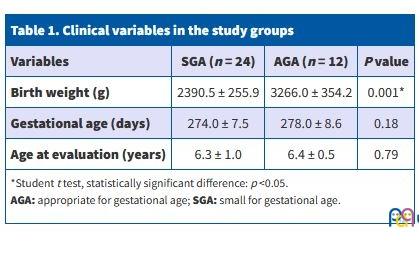
A total of 36 children born at term participated in the study and were divided into two groups. The SGA group consisted of 24 children (12 male and 12 female) and the control AGA control group 12 children (6 male and 6 female). Table 1 summarizes the data on birth weight, gestational age and age at the time of the hearing evaluation.
| Table 1. Clinical variables in the study groups | |||
|---|---|---|---|
| Variables | SGA (n = 24) | AGA (n = 12) | P value |
| Birth weight (g) | 2390.5 ± 255.9 | 3266.0 ± 354.2 | 0.001* |
| Gestational age (days) | 274.0 ± 7.5 | 278.0 ± 8.6 | 0.18 |
| Age at evaluation (years) | 6.3 ± 1.0 | 6.4 ± 0.5 | 0.79 |
|
*Student t test, statistically significant difference: p <0.05. |
|||
Results of the audiological evaluation
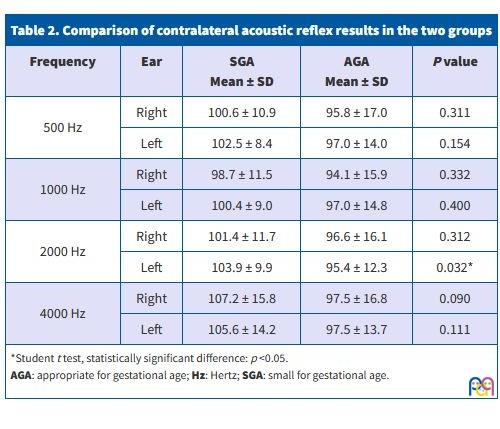
Pure-tone and speech audiometry revealed normal hearing thresholds in both groups. Contralateral acoustic reflexes were present in all participants. There were no significant intragroup differences. Table 2 presents the data on the intergroup comparison of acoustic reflex thresholds. We found a statistically significant difference between the groups at 2000 Hz in the left ear (p = 0.032).
| Table 2. Comparison of contralateral acoustic reflex results in the two groups | ||||
|---|---|---|---|---|
| Frequency | Ear | SGA Mean ± SD |
AGA Mean ± SD |
P value |
| 500 Hz | Right | 100.6 ± 10.9 | 95.8 ± 17.0 | 0.311 |
| Left | 102.5 ± 8.4 | 97.0 ± 14.0 | 0.154 | |
| 1000 Hz | Right | 98.7 ± 11.5 | 94.1 ± 15.9 | 0.332 |
| Left | 100.4 ± 9.0 | 97.0 ± 14.8 | 0.400 | |
| 2000 Hz | Right | 101.4 ± 11.7 | 96.6 ± 16.1 | 0.312 |
| Left | 103.9 ± 9.9 | 95.4 ± 12.3 | 0.032* | |
| 4000 Hz | Right | 107.2 ± 15.8 | 97.5 ± 16.8 | 0.090 |
| Left | 105.6 ± 14.2 | 97.5 ± 13.7 | 0.111 | |
|
*Student t test, statistically significant difference: p <0.05. |
||||
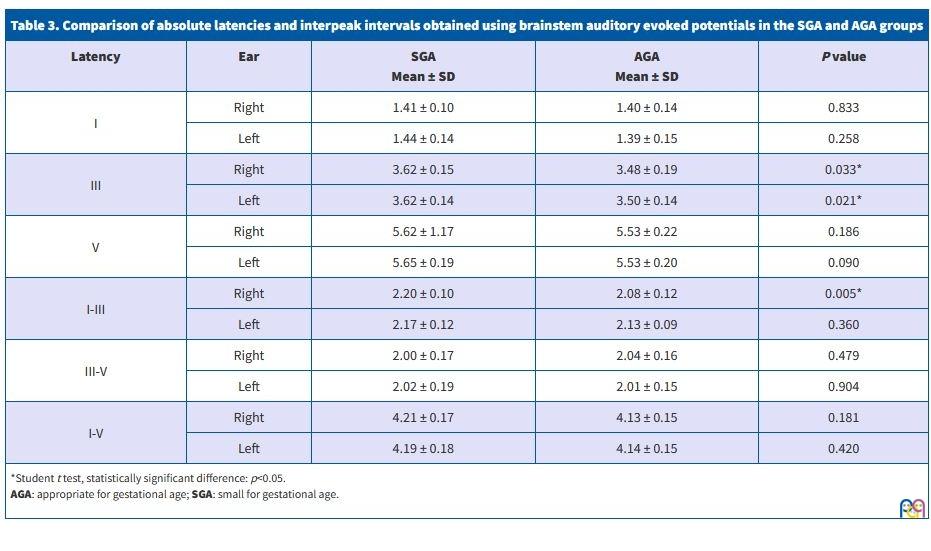
The electrophysiological assessment by means of BAEP included the analysis of the absolute latencies of waves I, III, and V as well as the I-III, III-V, and I-V interpeak intervals. There were no significant intragroup differences between the left and right ears. In the intergroup analysis, we found significant differences in the absolute latency of wave III in both ears (right ear: p = 0.033; left ear: p = 0.021) and in the I-III interpeak interval in the right ear (p = 0.005), as can be seen in Table 3.
| Table 3. Comparison of absolute latencies and interpeak intervals obtained using brainstem auditory evoked potentials in the SGA and AGA groups | ||||
|---|---|---|---|---|
| Latency | Ear | SGA Mean ± SD |
AGA Mean ± SD |
P value |
| I | Right | 1.41 ± 0.10 | 1.40 ± 0.14 | 0.833 |
| Left | 1.44 ± 0.14 | 1.39 ± 0.15 | 0.258 | |
| III | Right | 3.62 ± 0.15 | 3.48 ± 0.19 | 0.033* |
| Left | 3.62 ± 0.14 | 3.50 ± 0.14 | 0.021* | |
| V | Right | 5.62 ± 1.17 | 5.53 ± 0.22 | 0.186 |
| Left | 5.65 ± 0.19 | 5.53 ± 0.20 | 0.090 | |
| I-III | Right | 2.20 ± 0.10 | 2.08 ± 0.12 | 0.005* |
| Left | 2.17 ± 0.12 | 2.13 ± 0.09 | 0.360 | |
| III-V | Right | 2.00 ± 0.17 | 2.04 ± 0.16 | 0.479 |
| Left | 2.02 ± 0.19 | 2.01 ± 0.15 | 0.904 | |
| I-V | Right | 4.21 ± 0.17 | 4.13 ± 0.15 | 0.181 |
| Left | 4.19 ± 0.18 | 4.14 ± 0.15 | 0.420 | |
|
*Student t test, statistically significant difference: p<0.05. |
||||
DISCUSSION
Previous studies have shown that being born SGA can affect the maturation of the auditory pathway, particularly during the neonatal period and early childhood. However, it is unclear whether these alterations persist in later stages of childhood. In our study, we assessed children born SGA at term at ages 5 to 9 years for hearing impairment and compared them with a control group of children born AGA.
Pure-tone and speech audiometry indicated preserved hearing sensitivity. However, we found a difference between the groups in the assessment of the acoustic reflex pathway: the acoustic reflex thresholds at 2 kHz in the left ear were significantly higher in the SGA group compared to the AGA group. In the analysis of BAEP, we found prolongation of the latencies in waves III and V and of the I-V interpeak interval in the SGA group compared to the AGA group.
The assessment of acoustic reflexes revealed increased thresholds in the SGA group (although only at 2 kHz). Since the results of tympanometry were normal (type A tympanograms), otoacoustic emissions were present and the audiometric thresholds were normal, this finding could support the hypothesis of retrocochlear compromise probably associated with a central auditory processing disorder.
Acoustic reflexes are an established tool used to assess the integrity of the auditory pathway in clinical audiology. The reflex arc involves structures in the brainstem—specifically, the cochlear nucleus and the superior olivary complex—that transmit signals through the efferent auditory system.29,30 Physiologically, the efferent auditory system provides two types of feedback: one pathway regulates cochlear amplification through the outer hair cells and another modulates the excitability of the cochlear nerve.31
Efferent auditory system dysfunction—especially at the level of the medial olivocochlear system—can reduce cochlear inhibition and, consequently, affect hearing skills, such as speech discrimination, sound localization and noise tolerance. These impairments may go undetected in conventional hearing testing protocols.32
In this context, acoustic reflex testing through facilitating stimuli has been studied as a means to assess the medial olivocochlear reflex arc in individuals with auditory processing impairment, since they tend to have altered acoustic reflex thresholds that could be indicative of some compromise in the cochlear protection function, which would hinder speech discrimination in environments with loud and competing noise.33,34
Acoustic reflex abnormalities have been associated with auditory processing disorders, especially in individuals with normal peripheral hearing. A study conducted in 100 participants aged 7 to 18 years showed that 97% had some form of auditory processing disorder and, of these, 62% had abnormal acoustic reflexes despite normal audiometry results.35 Other studies support this relationship, finding a close association between auditory processing disorders and acoustic reflex abnormalities in subjects with normal peripheral hearing.36-38
Previous research on the medial olivocochlear system suggests that this reflex matures before the pregnancy comes to term; however, preterm infants or those with a history of intrauterine growth restriction may present abnormalities due to disrupted synaptogenesis or neural development.39 In our review of the literature published to date, we found no studies that specifically evaluated acoustic reflex profiles in children born full-term and SGA. However, the analysis of abnormalities in acoustic reflexes could signal the need to establish hearing assessment protocols that include auditory processing and, in the event of abnormal findings, enable prompt intervention.
In our study, the BAEP results revealed a difference in the latency of wave III between the SGA and AGA groups, with prolongation of wave III in both ears in addition to a significant increase in the I-III interpeak interval in the right ear in children born SGA. Given that the maturation of the auditory system is completed between 18 and 24 months of age40 and progresses from the periphery to the central nervous system,41 this pattern, observed in children aged 5 to 9 years, could suggest a delay in the maturation of the auditory nervous system. The I-III interval is mainly associated with the development of the lower portion of the brainstem, while the III-V interval reflects the function of the upper portion. In our study, interpeak intervals in children born SGA showed similar trends to those of their AGA peers, but with substantial intersubject variation. The III-V/I-III ratio has been used in previous studies to differentiate specific brainstem impairments. In children born AGA, the lower brainstem matures slightly faster than the upper brainstem; in contrast, children born SGA showed signs of unsynchronized maturation, possibly as a result of IUGR.
Among the methods used in previous studies to assess auditory nervous system maturation in full-term neonates born SGA, BAEP has been the most common. Early studies found prolongation of waves III and V latencies and the I-V interpeak interval, which would indicate delayed transmission in the brainstem.20,42 Contradictory findings have since been reported: some studies found evidence of shorter conduction times (for instance, a shorter wave V latency), while others attributed the reduction in the I-V interval to incomplete cochlear maturation as opposed to faster central conduction.15 However, other studies have not found significant differences between children born SGA and AGA, suggesting that reported outcomes vary depending on the methodology, age of assessment and clinical context.16,18,19,21.
Wave III originates in the cochlear nucleus, which is also involved in the processing of the acoustic reflex. The prolongation of the latency of wave III and the increase in the acoustic reflex thresholds observed in SGA children reinforce the hypothesis of persistent dysfunction in this region even past the typical maturation period.
In the SGA group, increases in acoustic reflex thresholds, delays in wave III and prolongation of the I-III interpeak interval in children aged 5 to 9 years with normal peripheral hearing suggest the presence of subclinical hearing loss. This could indicate a condition in which damage to the auditory system is not sufficient to produce a threshold shift or in which the auditory system partially recovers to restore original thresholds despite residual physical damage. The causes of retrocochlear hearing loss in early childhood are not fully understood yet.
These hearing deficits appear to be closely associated with intrauterine growth restriction (IUGR). Adverse intrauterine conditions—whether due to maternal nutritional deficiencies, placental insufficiency, or environmental exposures—can interfere with synaptogenesis, myelination and glial development, especially during the rapid brain growth phase that begins in the second trimester and continues until early childhood.13,21,43 This highlights the importance of long-term follow-up of full-term infants born SGA. Even in the absence of overt hearing loss, subtle retrocochlear deficits could affect language development, communication and cognitive performance if not detected early.
Chief among the limitations of this study is the relatively small sample size, which may have limited the detection of more subtle differences between groups. In addition, we were unable to determine the specific etiological factors that led to SGA status in participants with this history. Among the strengths of this study are the application of a standardized methodology and the strict characterization of patients, recruited from a cohort of SGA children followed up by a multidisciplinary team in outpatient clinics, which allowed for the diagnosis of subclinical hearing impairments (retrocochlear deficits) in this population.
Future studies should be conducted in larger samples and include longitudinal follow-up into adolescence and adulthood to determine the etiology of changes in the different anatomical structures that contribute to the retrocochlear deficits observed in children born SGA. Additional diagnostic tests, such as neuroimaging studies or biochemical markers, could also help elucidate the mechanisms linking SGA status in full-term children to auditory pathway development outcomes.
CONCLUSION
Children born small for gestational age at term may have retrocochlear dysfunction despite having normal peripheral hearing thresholds. Consequently, these children should be considered at risk for auditory pathway integrity abnormalities, and audiological follow-up at regular intervals is recommended, particularly during school age (5 to 9 years), to enable detection of potential late manifestations.
CONFLICTS OF INTEREST
The authors have no conflicts of interest to declare in relation to the preparation and publication of this article.
AUTHORSHIP
Author contributions: study concept, literature review, analysis and interpretation of the results, drafting of the manuscript (DSS), study concept, data collection, analysis, and interpretation and final review of the manuscript (LCF), statistical analysis and interpretation of results (MRRL), data collection and final review of the manuscript (NVFR), data interpretation and final review of the manuscript (ACNC), study concept and final review of the manuscript (CADA).
ABBREVIATIONS
AGA: appropriate for gestational age · BAEP: brainstem auditory evoked potentials · IUGR: intrauterine growth restriction · TOAE: transient otoacoustic emissions · SGA: small for gestational age.
REFERENCES
- Alexander G, Himes J, Kaufman R, Mor J, Kogan M. A United States national reference for fetal growth. Obstet Gynecol. 1996;87(2):163-8. https://doi.org/10.1016/0029-7844(95)00386-X.
- Boguszewski MCS, Mericq V, Bergada I, Damiani D, Belgorosky A, Gunczler P, et al. Consenso Latinoamericano: Niños pequeños para la edad gestacional. BMC Pediatr. 2011;11:66. https://doi.org/10.1186/1471-2431-11-66.
- Qi Y, Wang X, Mao J. Quantitative assessment of cerebral metabolism and hemodynamics in small-for-gestational-age newborns. Quant Imaging Med Surg. 2021;11(6):2321-32. https://doi.org/10.21037/qims-20-1040
- He H, Miao H, Liang Z, Zhang Y, Jiang W, Deng Z, et al. Prevalence of small for gestational age infants in 21 cities in China, 2014-2019. Sci Rep. 2021;11:7500. https://doi.org/10.1038/s41598-021-87127-9.
- Teixeira MPC, Queiroga TPR, Mesquita MDA. Frequency and risk factors for the birth of small-for-gestational-age newborns in a public maternity hospital. Einstein (Sao Paulo). 2016;14(3):317-23. https://doi.org/10.1590/S1679-45082016AO3684
- Clayton PE, Cianfarani S, Czernichow P, Johannsson G, Rapaport R, Rogol A. Management of the child born small for gestational age through to adulthood: a consensus statement of the International Societies of Pediatric Endocrinology and the Growth Hormone Research Society. J Clin Endocrinol Metab. 2007;92(3):804-10. https://doi.org/10.1210/jc.2006-2017.
- Finken MJJ, van der Steen M, Smeets CCJ, Walenkamp MJE, de Bruin C, Hokken-Koelega ACS, et al. Children Born Small for Gestational Age: Differential Diagnosis, Molecular Genetic Evaluation, and Implications. Endocr Rev. 2018;39(6):851-94. https://doi.org/10.1210/er.2018-00083. Erratum in: Endocr Rev. 2019;40(1):96. https://doi.org/10.1210/er.2018-00278.
- Yadav S, Rustogi D. Small for gestational age: growth and puberty issues. Indian Pediatr. 2015;52(2):135-40. https://doi.org/10.1007/s13312-015-0588-z
- Sacchi C, Marino C, Nosarti C, Vieno A, Visentin S, Simonelli A. Association of intrauterine growth restriction and small for gestational age status with childhood cognitive outcomes. JAMA Pediatr. 2020;174(8):772-81. https://doi.org/10.1001/jamapediatrics.2020.1097
- Rios NVF, Fernandes LC, Andrade CLO, Santiago AC, Alves CAD. Phonological processes in schoolchildren born at term and small for gestational age: case-control study. CoDAS. 2022;34(2):e20200340. https://doi.org/10.1590/2317-1782/20212020340
- Viggedal G, Carlsson G, Hugdahl K. Language asymmetry and auditory attention in young adulthood after being born small-for-gestational age or with cardio-pulmonary resuscitation at birth. Child Neuropsychol. 2004;10(3):195-200. https://doi.org/10.1080/09297040409609810
- Angrisani RG, Matas CG, Diniz EMA, Guinsburg R, Azevedo MF. Electrophysiological follow-up of the central auditory system in children born small for gestational. Audiol Commun Res. 2020;25:e2251. https://doi.org/10.1590/2317-6431-2019-2251.
- Sarda P, Dupuy RP, Boulot P, Rieu D. Brainstem conduction time abnormalities in small for gestational age infants. Electroencephalogr Clin Neurophysiol. 1992;20(1):57-63. https://doi.org/10.1515/jpme.1992.20.1.57
- Jiang ZD, Brosi DM, Wu YY, Wilkinson AR. Relative maturation of peripheral and central regions of the human brainstem from preterm to term and the influence of preterm birth. Pediatr Res. 2009;65(6):657-62. https://doi.org/10.1203/PDR.0b013e31819ed5ae
- Soares I, Collet l, Morgon A, Salle B. Effect of brainstem auditory evoked potential stimulus intensity variations in neonates of small for gestational age. Brain Dev. 1988;10(3):174-7. https://doi.org/10.1016/S0387-7604(88)80023-8
- Angrisani RMG, Diniz EMA, Azevedo MF, Matas CG. The influence of body proportionality on children born small for gestational age: a study of auditory pathway maturation. Audiol Commun Res. 2015;20(1):32-9.
- Angrisani RG, Azevedo MF, Carvallo RM, Diniz EM, Matas CG. Electrophysiological study of hearing in full-term small-for-gestational-age newborns. J Soc Bras Fonoaudiol. 2012;24:162-7. https://doi.org/10.1590/S2179-64912012000200013
- Angrisani RMG, Bautzer AP, Matas CG, Azevedo MF. Auditory brainstem response in neonates: influence of gender and weight/gestational age ratio. Rev Paul Pediatr. 2013;31(4):494-500. https://doi.org/10.1590/S0103-05822013000400012
- Angrisani RG, Diniz EM, Guinsburg R, Ferraro AA, Azevedo MF, Matas CG. Longitudinal electrophysiological study of auditory pathway in small-for-gestational-age infants. CoDAS. 2014;26(4):294-301. https://doi.org/10.1590/2317-1782/201420140042
- Eldredge l, Salamy A. Functional auditory development in preterm and full-term infants. Early Hum Dev. 1996;45(3):215-28. https://doi.org/10.1016/0378-3782(96)01732-x
- Mahajan V, Gupta P, Tandon O, Aggarwal A. Brainstem auditory evoked responses in term small for gestational age newborn infants born to undernourished mothers. Eur J Paediatr Neurol. 2003;7(2):67-72. https://doi.org/10.1016/s1090-3798(03)00015-1
- Jiang ZD, Wu YY, Zhen MS, Sun DK, Feng LY, Peng YM, et al. Development of early and late brainstem conduction time in normal and intrauterine growth retarded children. Acta Paediatr Scand. 1991;80(5):494-9. https://doi.org/10.1111/j.1651-2227.1991.tb11892.x
- Strauss RS. Adult functional outcome of those born small for gestational age: twenty-six-year follow-up of the 1970 British Birth Cohort. JAMA. 2000;283(5):625-32. https://doi.org/10.1001/jama.283.5.625.
- Hollo O, Rautava P, Korhonen T, Helenius H, Kero P, Sillanpää M. Academic achievement of small-for-gestational-age children at age 10 years. Arch Pediatr Adolesc Med. 2002;156(2):179–87. https://doi.org/10.1001/archpedi.156.2.179
- Naz S, Hoodbhoy Z, Jaffar A, Kaleem S, Hasan BS, Chowdhury D, et al. Neurodevelopment assessment of small for gestational age children in a community-based cohort from Pakistan. Arch Dis Child. 2022;107(1):e6. https://doi.org/10.1136/archdischild-2022-324630
- Capurro H, Konichezky S, Fonseca D, Caldeyro-Barcia R. A simplified method for diagnosis of gestational age in the newborn infant. J Pediatr. 1978;93(1):120–2. https://doi.org/10.1016/s0022-3476(78)80621-0
- Ballard JL, Novak KK, Driver M. A simplified score for assessment of fetal maturation of newly born infants. J Pediatr. 1979;95(5):769–74. https://doi.org/10.1016/s0022-3476(79)80734-9
- Jerger J. Clinical experience with impedance audiometry. Arch Otolaryngol. 1970;92(4):311-24. https://doi.org/10.1001/archotol.1970.04310040005002
- Guinan JJJ. Olivocochlear efferents: anatomy, physiology, function, and the measurement of efferent effects in humans. Ear Hear. 2006;27(6):589-607. https://doi.org/10.1097/01.aud.0000240507.83072.e7
- Borg E. On the neuronal organization of the acoustic middle ear reflex. A physiological and anatomical study. Brain Res. 1973;49(1):101-23. https://doi.org/10.1016/0006-8993(73)90404-6
- Coelho A, Ćeranić B, Prasher D, Miller DH, Luxon LM. Auditory efferent function is affected in multiple sclerosis. Ear Hear. 2007;28(5):593-604. https://doi.org/10.1097/AUD.0b013e31812f716e
- Liberman MC, Liberman LD, Maison SF. Efferent feedback slows cochlear aging. J Neurosci. 2014;34(13):4599-607. https://doi.org/10.1523/JNEUROSCI.5273-13.2014.
- Burguetti FAR, Carvallo RMM. Efferent auditory system: its effect on auditory processing. Braz J Otorhinolaryngol. 2008;74(5):737-45. https://doi.org/10.1523/JNEUROSCI.4923-13.2014
- Fronza AB, Barreto DC, Tochetto TM, Cruz IB, Silveira AF. Associação entre funções da via auditiva eferente e genotoxicidade em adultos jovens [Association between auditory pathway efferent functions and genotoxicity in young adults]. Braz J Otorhinolaryngol. 2011;77(1):107-14. https://doi.org/10.1590/s1808-86942011000100018
- Meneguello J, Domenico MLD, Costa MCM, Leonhardt FD, Barbosa LHF, Pereira LD. Acoustics reflex abnormalities in auditory processing disorder. Rev Bras Otorrinolaringol. 2001;67(6):830-5.
- Marotta RMB, Quintero SM, Marone SAM. Assessment of auditory processing by SSW test applied to individuals with normal hearing and absence of contralateral acoustic reflex. Rev Bras Otorrinolaringol. 2002;68(2):254-61.
- May BJ, Budelis J, Niparko JK. Behavioral studies of the olivocochlear efferent system: learning to listen in noise. Arch Otolaryngol Head Neck Surg. 2004;130(5):660-4. https://doi.org/10.1001/archotol.130.5.660
- Attoni TM, Mota HB. Study and analysis of contralateral acoustic reflex in children with phonological disorder. Braz J Otorhinolaryngol. 2010;76(2):231-7. https://doi.org/10.1590/S1808-86942010000200014
- Abdala C, Mishra S, Garinis A. Maduración del reflejo eferente medial humano revisitada. J Acoust Soc Am. 2013;133:938-50. https://doi.org/10.1121/1.4773265
- Dobbing J, Sands J. Head circumference, biparietal diameter and brain growth in fetal and postnatal life. Early Hum Dev. 1978;2(1):81-7. https://doi.org/10.1016/0378-3782(78)90054-3
- Eggermont JJ, Ponton CW. Auditory-evoked potential studies of cortical maturation in normal hearing and implanted children: correlations with changes in structure and speech perception. Acta Otolaryngol (Stockh). 2003;123(2):249-52. https://doi.org/10.1080/0036554021000028098
- Saintonge J, Lavoie A, Lachapelle J, Côté R. Brain maturity in regard to the auditory brainstem response in small-for-date neonates. Brain Dev. 1986;8(1):1–5. https://doi.org/10.1016/S0387-7604(86)80112-7
- Pryor J. The identification and long term effects of fetal growth restriction. BJOG Int J Obstet Gynaecol. 1997;104(10):1116–22. https://doi.org/10.1111/j.1471-0528.1997.tb10933.x