





Vol. 28 - Num. 110
Original Papers
Depression and self-esteem problems as a function of body mass index
María Ángeles Piedecausa Valeroa, Pedro Saura Garreb, Javier González de Diosc
aServicio de Pediatría. Hospital General Universitario de Elche. Alicante. España.
bDoctor en Psicología por la Facultad de Psicología de la Universidad de Murcia. España.
cServicio de Pediatría. Hospital General Universitario Dr. Balmis. Departamento de Pediatría. Universidad Miguel Hernández. ISABIAL-Instituto de Investigación Sanitaria y Biomédica. Alicante. España.
Correspondence: MA Piedecausa. E-mail: mpv.pediatria@gmail.com
Reference of this article: Piedecausa Valero MA, Saura Garre P, González de Dios J. Depression and self-esteem problems as a function of body mass index . Rev Pediatr Aten Primaria. 2026;28:179-86. https://doi.org/10.60147/050b8cbe
Published in Internet: 14-04-2026 - Visits: 3552
Abstract
Introduction: obesity is an increasingly prevalent condition in pediatric populations. Recent studies indicate that obesity is not only associated with organic comorbidities, but also with psychological disorders that may go unnoticed, significantly affecting quality of life.
Materials and Methods: we conducted a cross-sectional descriptive observational study in 60 patients aged 7 to 14 years managed in a pediatric emergency department. Patients with overweight/obesity were compared with those with normal weight. We analyzed the association between body mass index (BMI) and the risk of developing psychological conditions such as depression or low self-esteem during childhood.
Results: of the 60 patients, 35 belonged to the normal weight group and 25 to the overweight/obesity group. Depression was identified using the Children’s Depression Inventory (CDI) in two patients (5%) in the normal-weight group compared to 11 patients (44%) in the overweight/obesity group (OR 12.96, CI 2.53-66.2). Self-esteem problems were detected by means of the Rosenberg scale in 22 patients (63%) in the normal-weight group compared to 22 patients (88%) in the overweight/obesity group (OR 4.33, CI 1.08-17.35). Regarding physical activity, 95% of normal-weight patients engaged in exercise compared to 80% of those with overweight/obesity (OR 0.24, CI 0.043-1.36).
We performed a multivariate logistic regression analysis to identify factors associated with self-esteem problems and found that physical activity acted as a protective factor (OR 0.184, CI 0.04-0.75).
Conclusion: overweight and obesity are associated with an increased risk of depression and self-esteem problems in the pediatric population aged 7 to 14 years. Physical activity is associated with a reduction in depression and in the risk of self-esteem problems.
Keywords
● BMI ● Body image distortion ● Depression ● Low self-esteem ● Obesity ● OverweightINTRODUCTION
Childhood and adolescent obesity (CAO) has become one of the leading global public health problems of the twenty-first century.1 In Spain, in 2023, the prevalence of obesity in the pediatric population was estimated at 10%, and the prevalence of overweight (OW) at 30%, without relevant differences between the sexes. Obesity is a chronic and multifactorial disease whose etiology involves biological, behavioral and psychosocial factors, including lifestyles characterized by inadequate nutrition and insufficient physical activity.2
The determinants of health play a key role in childhood obesity. Commercial determinants of health, such as marketing strategies that promote consumption of ultra-processed foods and sugar-sweetened beverages, create obesogenic food environments and directly influence nutritional intake and food preferences from an early age, with a particular impact on children and adolescents.3 Furthermore, the advertising of food products high in fat, sugar, and salt and marketing targeted at children have been identified as factors that increase children’s preference for unhealthy products and promote high energy intakes, contributing to the development of excess weight from a young age.
On the other hand, socioeconomic status is a social determinant of health that affects the distribution of childhood obesity. Some studies, such as ALADINO,4 show a clear socioeconomic gradient, with higher rates of obesity among children from households with lower socioeconomic status or higher poverty levels compared to children from higher-income households (23.2% vs. 11.9%). This trend may be associated with differences in access to healthy foods, food insecurity, and less healthy lifestyles, which tend to be more prevalent in lower-income settings. Similarly, it may also be related to cultural and structural factors in the social environment.4
Combined, these social and commercial determinants shape environments where the risk of obesity is distributed unevenly, with higher rates of childhood obesity found in disadvantaged socioeconomic settings, contributing to health inequalities from an early age. Recent studies in Spain have shown that these patterns of inequality are reflected in dietary habits, levels of physical activity, access to healthy environments, and the prevalence of overweight in relation to the socioeconomic status of the household.5 On the other hand, childhood obesity has traditionally been associated with underlying organic diseases such as diabetes, hypertension, hypercholesterolemia, and sleep apnea. However, in recent years, there has been growing interest on its association with psychological disorders that may go undetected, such as depression,6,7 low self-esteen,8 body image distortion, and eating disorders. These conditions have a negative impact on quality of life and can lead to serious consequences, including suicidal ideation. Body image plays a central role in today’s society and is defined as the internal representation each person has of their own body or outer appearance. Children begin to exhibit concern about their physical appearance from an early age, and there is evidence than those with CAO or OW experience greater body dissatisfaction and are more likely to have a negative body image.9 This dissatisfaction can negatively impact self-esteem and contribute to the development of psychological disorders, especially when children feel they do not meet social standards. In addition, these children may experience discrimination, marginalization, or bullying, factors that increase the likelihood of affective disorders. In fact, some studies have estimated the prevalence of depression in children with excess weight at approximately 30% to 40%.6,7 In the pediatric population, habits and behavioral patterns are established early in life and tend to persist into adulthood. It is estimated that childhood obesity or OW persists or worsens over time in up to 80% of cases. Therefore, childhood obesity should be considered a global problem, one that can be prevented through early interventions aimed at modifying lifestyles, reducing comorbidities, and improving long-term quality of life.10
In this context, we conducted a study based on the hypothesis that children and adolescents aged 7 to 14 years with a high body mass index (BMI) are at increased risk of depression and low self-esteem compared to their normal-weight peers. The primary objective was to analyze the relationship between the BMI and these psychological disorders, as well as to explore the factors associated with their onset and how body image may contribute to their development.
MATERIAL AND METHODS
Design: cross-sectional, observational, descriptive study comparing two groups classified according to BMI: patients with CAO/OW (BMI ≥ 85th percentile), and patients with normal weight (BMI between 5th and 85th percentiles), who served as the control group.
The data were collected by means of questionnaires, including information on the patient's personal history, anthropometric measurements, weekly physical activity, bullying and family situation, and specific assessments with the Children’s Depression Inventory (CDI), the Rosenberg Self-Esteem scale, and the Collins Figure Rating Scale (used to assess perceived body image).
The sample included 60 patients (35 with normal weight and 25 with CAO/OW). We selected patients aged 7 to 14 years managed in the pediatric emergency department for whom anthropometric measurements were available.
Inclusion criteria: Age 7 to 14 years, visit to the pediatric emergency department, absence of underlying medical conditions with an impact on quality of life, BMI ≥18.5, and informed consent.
Exclusion criteria: history of psychological/psychiatric disorder, underlying disease with emotional or functional impact, BMI ≤18.5 and refusal to provide consent.
Primary variables:
- Weight status classification based on the BMI percentile: normal weight, between the 5th and 85th percentiles, overweight between the 85th and 97th percentiles, and obesity, above the 97th percentile in the BMI-for-age charts of the World Health Organization (WHO).11
- Children’s Depression Inventory: assesses signs of depression in children aged 7 to 17 years, a score of 19 or greater is indicative of depression.
- Rosenberg Self-Esteem scale: scores under 15, of 15-25, and of 30 or greater are indicative of low, normal and high self-esteem, respectively.
- Collins’ Figure Rating Scale: it presents seven figures ordered by increasing weight, used to have patients show their perceived body shape and their ideal body shape to assess their body image.
Secondary variables: we collected data on age, sex, the family psychiatric history, household socioeconomic status, physical activity (days/week) and school bullying. The bullying variable encompassed the following types of bullying, of which examples were provided to improve comprehension:
- Verbal bullying, including insults, mockery, name-calling…
- Social bullying, which manifests through rejection by the group.
- Psychological bullying, which seeks to make the victim feel inferior.
- Physical bullying, including pushing, kicking…
- Cyberbullying, which chiefly takes place through social media or group chats, in which the victim is harassed with jokes or memes, threats, or even through the publication of contents without consent.
The patient was only asked to indicate whether or not they had been bullied at school, without specifying the type of bullying they experienced.
Statistical analysis: Quantitative variables were dichotomized. Weight status was classified as CAO/OW (BMI ≥ 85th percentile) or normal weight (5th-85th percentile); the CDI score as indicative of depression (>19) or not; the Rosenberg scale as indicative of low self-esteem (<25) or not; and, for the Collins scale, the actual and perceived body image were compared to determine whether body distortion was present. Differences were assessed using the χ2 test or the Fisher exact test. We calculated odds ratios (ORs), and statistical significance was defined as p < 0.05.
Ethical considerations: Informed consent, adapted to the pediatric age group, was obtained for all patients, and signed by both the patient and a legal guardian.
RESULTS
Table 1 shows the baseline characteristics of the sample: a total of 60 patients, of whom 35 (58%) were in the normal-weight group and 25 (42%) in the CAO/OW group. Fifty-two percent of patients were male. Of note, there were differences between groups in the sex distribution, as female patients predominated in the normal-weight group (57%) and male patients in the CAO/OW group (64%).
| Table 1. Characteristics of the sample | ||||
|---|---|---|---|---|
| Variable n (%) | Normal weight n = 35 (58%) |
Overweight/Obesity n = 25 (42%) |
Total | p value |
| Sex | ||||
| Male | 15 (43%) | 16 (64%) | 31 (52%) | 0.106 |
| Female | 20 (57%) | 9 (36%) | 29 (48%) | |
| Age | ||||
| 7-11 years | 20 (57%) | 9 (36%) | 29 (48%) | 0.106 |
| 12-14 years | 15 (43%) | 16 (64%) | 31 (52%) | |
| CDI | ||||
| No depression | 33 (95%) | 14 (56%) | 47 (78%) | <0.001 |
| Depression | 2 (5%) | 11 (44%) | 13 (22%) | |
| Rosenberg | ||||
| Normal self-esteem | 13 (37%) | 3 (12%) | 16 (27%) | 0.040 |
| Abnormal self-esteem | 22 (63%) | 22 (88%) | 44 (73%) | |
| Body image | ||||
| Accurate perception | 18 (52%) | 3 (12%) | 21 (35%) | 0.002 |
| Distorted perception | 17 (48%) | 22 (88%) | 39 (65%) | |
| Physical activity | ||||
| No | 2 (5%) | 5 (20%) | 7 (12%) | 0.117 |
| Yes | 33 (95%) | 20 (80%) | 53 (88%) | |
| School bullying | ||||
| Yes | 24 (68%) | 10 (40%) | 34 (57%) | 0.036 |
| No | 11 (32%) | 15 (60%) | 26 (43%) | |
| CDI: Children’s Depression Inventory. | ||||
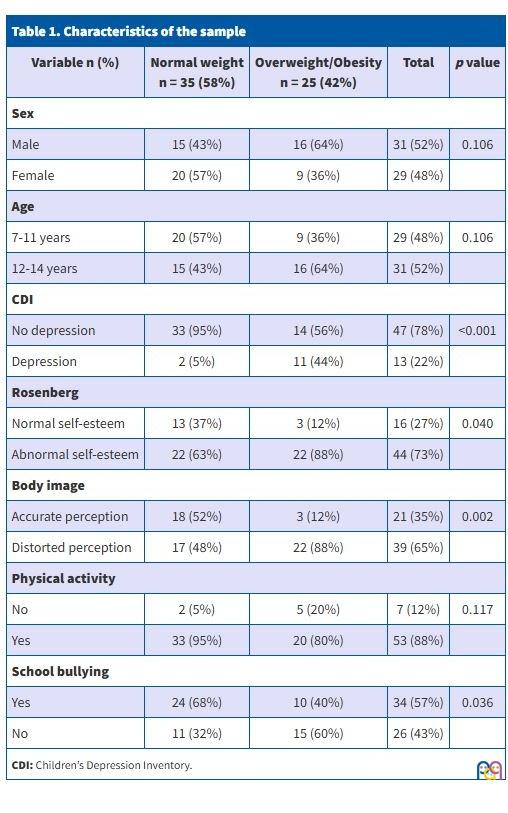
The CDI score was indicative of, depression in two patients (5%) in the normal-weight group, compared to 11 (44%) in the CAO/OW group (OR: 12.96; 95 CI: 2.53-66.2).
The Rosenberg Scale identified low self-esteem in 22 patients (63%) in the normal-weight group, compared to 22 (88%) in the CAO/OW group (OR: 4.33; 95 CI: 1.08-17.35).
Body image distortion was detected in 17 patients (48%) in the normal-weight group compared to 22 (88%) in the CAO/OW group (OR: 7.76; 95 CI: 1.96-30.74).
With regard to physical activity, 95% of patients with normal weight did exercise, compared to 80% of patients with CAO/OW. However, the differences were not statistically significant (OR: 0.24; 95 CI: 0.043-1.36).
Finally, in the assessment of bullying, 60% of patients with CAO/OW reported experiencing bullying compared to 32% of their normal-weight peers (OR: 3.27; 95 IC: 1.12-9.56).
Overall, the descriptive analysis showed that children with CAO/OW were predominantly male, at greater risk of depression and low self-esteem, more sedentary, and more likely to be subject to bullying.
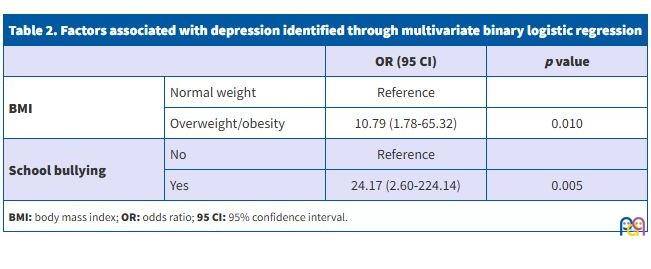
To identify factors associated with depression in children aged 7 to 14 years, we fitted a multivariate logistic regression model. We analyzed physical activity, body image distortion, BMI, bullying (of any kind), sex and age, and only found statistically significant differences in relation to BMI (OR: 10.79; 95 IC: 1.78-65.32, p = 0.010) and bullying (OR: 24.17; 95 IC: 2.60-224.14, p = 0.005) (Table 2).
| Table 2. Factors associated with depression identified through multivariate binary logistic regression | |||
|---|---|---|---|
| OR (95 CI) | p value | ||
| BMI | Normal weight | Reference | |
| Overweight/obesity | 10.79 (1.78-65.32) | 0.010 | |
| School bullying | No | Reference | |
| Yes | 24.17 (2.60-224.14) | 0.005 | |
| BMI: body mass index; OR: odds ratio; 95 CI: 95% confidence interval. | |||
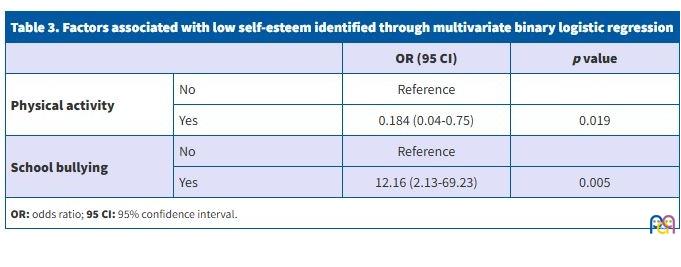
Similarly, to identify factors associated with self-esteem problems, we fitted another multivariate logistic regression model. We analyzed the association with physical activity, body image distortion, BMI, bullying, sex, and age, and only found statistically significant results for physical activity (OR: 0.184; 95 CI: 0.04-0.75, p = 0.019) and bullying (OR: 12.16; 95 CI: 2.3-69.23, p = 0.005) (Table 3).
| Table 3. Factors associated with low self-esteem identified through multivariate binary logistic regression | |||
|---|---|---|---|
| OR (95 CI) | p value | ||
| Physical activity | No | Reference | |
| Yes | 0.184 (0.04-0.75) | 0.019 | |
| School bullying | No | Reference | |
| Yes | 12.16 (2.13-69.23) | 0.005 | |
| OR: odds ratio; 95 CI: 95% confidence interval. | |||
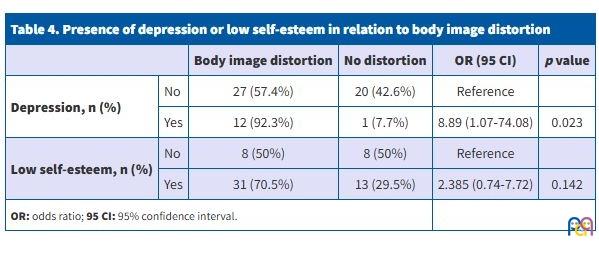
To analyze the relationship between body image and the presence of depression and low self-esteem, we used the recoded variable obtained through calculating the difference between the perceived and actual body shape. This allowed us to differentiate between patients who perceived themselves as more obese than they actually were (indicative of body image distortion) and those who perceived themselves as they were (absence of distortion). The proportion of patients with depression was greater in the subset that had body image distortion (OR: 8.89; 95 CI: 1.07-74.08; p = 0.023), but there was no significant difference in the prevalence of low self-esteem (OR: 2.38; 95 CI: 0.74-7.72; p = 0.142) (Table 4).
| Table 4. Presence of depression or low self-esteem in relation to body image distortion | |||||
|---|---|---|---|---|---|
| Body image distortion | No distortion | OR (95 CI) | p value | ||
| Depression, n (%) | No | 27 (57.4%) | 20 (42.6%) | Reference | |
| Yes | 12 (92.3%) | 1 (7.7%) | 8.89 (1.07-74.08) | 0.023 | |
| Low self-esteem, n (%) | No | 8 (50%) | 8 (50%) | Reference | |
| Yes | 31 (70.5%) | 13 (29.5%) | 2.385 (0.74-7.72) | 0.142 | |
| OR: odds ratio; 95 CI: 95% confidence interval. | |||||
DISCUSSION
Childhood and adolescent obesity and overweight are major public health concerns both in Spain and worldwide. In our series, 42% of the patients managed in the pediatric emergency department were overweight or obese, which hints at the scale of the problem we are facing.
With regard to the distribution by sex, we did not find any statistically significant differences, although we found a greater prevalence of excess weight among male patients (64% of participants in the CAO/OW group were male, and 36% female). Previous studies have yielded contradictory results, with some indicating a higher prevalence in girls, and others showing no clear differences, which highlights the need to explore this issue further in larger samples.
One of the key findings in the current literature is the association between CAO/OW and mental health conditions such as depression6,7 or low self-esteem.6 Forty-four percent of patients with CAO/OW exhibited signs of depression, compared to 5% of their normal-weight peers, which corresponded to a significantly higher risk, with an OR of 12.96 (95 CI: 2.53-66.2). Similarly, 88% of obese patients exhibited low self-esteem compared with 63% of patients with normal weight, with an OR of 4.33 (95 CI: 1.08-17.35). These results were consistent with the findings of previous studies6-8 that also found an association between CAO, an increased risk of depression, and low self-esteem. However, those studies found a higher prevalence of depression among obese girls, in contrast to our findings, as we did not find statistically significant differences according to sex: in the group with CAO, 20.7% of female patients had depression, compared to 22.6% of male patients.
Body image plays a significant role in mental health. In our study, 88% of patients with CAO/OW had a distorted body image (perceived themselves as being more obese than they were) compared to 48% of patients with normal weight. This was consistent with the results of several previous studies2,9 that show that children with CAO/OW tend to perceive their own weight as greater than it actually is, exhibiting a distorted body image. In addition, the risk of depression was greater in the subset of patients that perceived their excess weight as being larger than it actually was, with a prevalence of 92% and an OR of 8.89 (95 CI: 1.07-74.08), which evinces the impact of body image on emotional wellbeing. It is worth noting that none of the patients in the sample perceived themselves as being slimmer than they were, in contrast to the findings of other studies, such as those by Sánchez and Ruiz2 or García and Ortega,12 in which large percentages of children tended to underestimate their excess weight, selecting figures that were slimmer than they actually were. This discrepancy could be due to cultural, socioeconomic, or environmental factors, or even methodological differences, and it merits more detailed exploration in future studies.
Several previous studies have examined the figures that mothers select as being representative of their children with OW and CAO, and found that a large percentage select figures that are slimmer,13 which indicates a lack of awareness of the weight problem of their children, and, therefore, that they may have difficulty assimilating the changes that need to be implemented. In our study, parents were asked to select the figure corresponding to their perception of the body shape of the child, but most of them did not complete that item, so we did not have sufficient data to analyze this aspect or draw valid conclusions.
School bullying of any type emerged as another significant factor, affecting 60% of patients with OW/CAO, compared to 32% of patients with normal weight. This finding confirms the vulnerability of these children to discrimination and stigmatization, factors that contribute to a decline in mental and social wellbeing in the long term. The multivariate analysis confirmed that bullying acted as a confounder in the association between obesity and depression, as patients who experienced bullying had a substantially higher risk of experiencing depressive symptoms (OR: 24.17; CI: 2.6-224.14). These results underscore the need to address childhood obesity not only from a clinical perspective, but also from social and educational perspectives.
On the other hand, physical activity, which was reported by 95% of patients with normal weight compared to 80% of patients with OW/CAO, emerged as a potential protective factor in relation to BMI. However, these results were not statistically significant, with an OR of 0.24 (95 CI: 0.043-1.36; p = 0.117). In contrast, the analysis did show that physical activity reduced the risk of low self-esteem, with an OR of 0.184 (95 CI: 0.04-0.75). Some studies12 have concluded that physical activity is beneficial not only for weight control, but also to improve self-esteem.
The findings of the study should be interpreted with caution due to its limitations.
First, the small sample size and the uneven distribution of certain characteristics between groups reduced the statistical power and limits the generalizability of the findings.
Second, the sample was selected from a single hospital and consists solely of patients managed in the pediatric emergency department, which introduces selection bias and limits the generalizability of the results to the general population.
Similarly, data were collected through self-report questionnaires, subjective measures that may have introduced bias in the findings, particularly since the study involved pediatric participants.
Another limitation of the study involved the approach to the collection of data on school bullying, which was addressed in a general manner to minimize intrusiveness, with its definition encompassing the different types of school bullying as opposed to asking patients to specify which type they were experiencing. This lack of specificity could be a source of heterogeneity in this variable and limit the interpretation of its impact on psychological wellbeing
In addition, we did not collect data for variables related to socioeconomic status or educational attainment in the family, factors that could also affect the patient's diet.
Finally, the lack of longitudinal follow-up precluded an evaluation of the evolution of symptoms over time and its association with changes in weight status or temporary psychosocial factors.
These limitations highlight the need for future multicenter studies in larger samples, with prospective designs, and with collection of data on bullying and socioeconomic factors related to the household and social environment, in order to confirm and expand upon these findings.
Despite these limitations, the study provides valuable insights by demonstrating the association between CAO/OW and certain mental health problems in childhood. These findings demonstrate the need for a multidisciplinary approach in the management of overweight and obesity, comprehending not only the prevention and treatment of excess weight, but also the early detection of its psychological and social repercussions.
CONCLUSION
To conclude, we must highlight that our study found that overweight and obesity in children and adolescents were associated with an increased risk of depression, low self-esteem, body image distortion, and bullying.
Early identification and a comprehensive approach to the management of these problems are essential in order to improve the quality of life of affected children and prevent their chronification.
CONFLICTS OF INTEREST
The authors have no conflicts of interest to declare in relation to the preparation and publication of this article.
AUTHORSHIP
Author contributions: primary investigator, data collection and analysis, and writing of manuscript (MAPV), collaboration in study design and data analysis (PSG), collaboration in study design and reporting of results (JGD).
ABREVIATIONS
BMI: body mass index · CAO: childhood and adolescent obesity · CDI: Children’s Depression Inventory · CI: confidence interval · OR: odds ratio · OW: overweight.
REFERENCES
- Ceballos-Macías MJ, Negrón-Juárez RP, Flores-Real JA, Vargas Sánchez J, Ortega-Gutiérrez G, Madriz-Prado R, et al. Obesidad. Pandemia del siglo XXI. Rev Sanid Milit Mex. 2018;72:332-8.
- Sánchez Arenas J, Ruiz Martínez J, Olivia A. Relación entre autoestima e imagen corporal en niños con obesidad. Revista mexicana de trastornos alimentarios. 2015; 6(1):38-44. https://doi.org/10.1016/j.rmta.2015.05.006
- World Health Organization. Commercial determinants of health. In: WHO [online] [accessed 23/03/2026]. Available at www.who.int/news-room/fact-sheets/detail/commercial-determinants-of-health
- Obesidad y Pobreza Infantil: Radiografía de una doble desigualdad. Estudio del rol de los factores socioeconómicos en la obesidad de los escolares en España. Informe breve.
- Agencia Española de Seguridad Alimentaria y Nutrición. Ministerio de Consumo. Alto Comisionado contra la Pobreza Infantil. Presidencia de Gobierno. Madrid, 2022. In: AESAN [online] [accessed 23/03/2026]. Available at www.aesan.gob.es/AECOSAN/docs/documentos/nutricion/observatorio/Obesidad_Pobreza.pdf
- Gutiérrez González E, García Solano M, Pastor Barriuso R, Fernández de Larrea N, Rollán Gordo A, Peñalver Argüeso V, et al. Socioeconomic and geographical disparities in the prevalence of obesity and excess weight in children and adolescents in Spain: Results from the ENE-COVID study. Rev Esp Salud Publica. 2019;93:e201904007.
- Ortega Miranda EG. Alteraciones psicológicas asociadas a la obesidad infantil. Rev Med Hered. 2018;29(2):111-5. https://doi.org/10.20453/rmh.v29i2.3352
- González Toche J, Gómez García A, Gómez Alonso C, Álvarez Paredes MA, Álvarez Aguilar C. Asociación entre obesidad y depresión infantil en población escolar de una unidad de medicina familiar en Morelia. Atención Familiar. 2017;24(1):8-12. https://doi.org/10.1016/j.af.2016.12.001
- Ortega Becerra MA, Muros JJ, Palomares Cuadros J, Martín Sánchez JA, Cepero González M. Influencia del índice de masa corporal en la autoestima de niños y niñas de 12-14 años. An Pediatr. 2015;83(5):311-7. https://doi.org/10.1016/j.anpedi.2014.11.017
- Pallares J, Baile J. Estudio de la obesidad infantil y su relación con la imagen corporal en una muestra española. Psycholog Av Disciplin. 2012;6(2):13-21.
- Alba Martín R. Evidencia científica sobre intervenciones preventivas en obesidad infantil. Rev Colomb Psiquiatr. 2017;46(1):36-43. https://doi.org/10.1016/j.rcp.2016.03.004
- World Health Organization. Body mass index for age (BMI-for-age). WHO Child Growth Standards. In: WHO [online] [accessed 23/03/2026]. Available at www.who.int/toolkits/child-growth-standards/standards/body-mass-index-for-age-bmi-for-age
- García Rodríguez K, Ortega Bravo AJ. Programa de intervención psicológica para el manejo de la obesidad infantil. Rev Hum Med. 2022;22(3):615-35.
- Nuño M, Hevia M, Bustos C, Florenzano R, Fritsch R. Distorsión de la imagen corporal en madres hacia sus hijos con sobrepeso u obesidad. Rev chilena de nutrición. 2017;44(1):28-32. http://dx.doi.org/10.4067/S0717-75182017000100004