





Vol. 28 - Num. 111
Original Papers
Sports eligibility in atrial and ventricular septal defects: practical implications for Primary Care
Alan García Yáneza, Andrea Carolina Pinzón Orregob, Alejandro Rodríguez Valenzuelab
aMédico especialista en Medicina del Deporte. Shinzo Sport Medicine. Investigador independiente. Bogotá. Colombia.
bResidente Medicina del Deporte. Universidad El Bosque. Programa de Especialización en Medicina del Deporte y del Ejercicio. Bogotá. Colombia.
Correspondence: A García. E-mail: imedica.agarciay@gmail.com
Reference of this article: García Yánez A, Pinzón Orrego AC, Rodríguez Valenzuela A. Sports eligibility in atrial and ventricular septal defects: practical implications for Primary Care . Rev Pediatr Aten Primaria. 2026;28:303-12. https://doi.org/10.60147/f0b875eb
Published in Internet: 10-07-2026 - Visits: 2396
Abstract
Introduction: atrial and ventricular septal defects are the most common congenital heart diseases in the pediatric population. Recommendations regarding physical activity and sports participation in these patients often raise uncertainties in clinical practice, particularly in primary care, where initial care is provided and referral decisions made.
Development: this narrative review summarizes the current scientific evidence and international guidelines on sports eligibility for children and adolescents with atrial and ventricular septal defects. Different clinical scenarios are analyzed according to defect type, hemodynamic significance, associated complications, and postsurgical or percutaneous closure status. The benefits of regular physical activity, the real versus perceived risks, and the importance of avoiding unnecessary restrictions are discussed.
Conclusions: most children and adolescents with atrial or ventricular septal defects without significant hemodynamic impairment can safely participate in physical activity and sports. Primary care pediatricians play a key role in identifying warning signs, promoting safe physical activity, and coordinating care with pediatric cardiology. An individualized, evidence-based approach supports cardiovascular health and overall development in this population.
Keywords
● Congenital heart defects ● Exercise ● SportsINTRODUCTION
Advances in early diagnosis, medical management, and open and percutaneous surgery techniques have significantly improved survival and quality of life for patients with congenital heart disease, allowing a growing number of children and adolescents to reach ages at which they can actively participate in school, recreational, and sports activities. Atrial septal defects (ASDs) and ventricular septal defects (VSDs) are the most common congenital heart defects and a frequent reason for ongoing medical follow-up, including in the primary care setting, due to the heterogeneity of their anatomical presentation, clinical course, and functional impact.
Recommendations regarding physical activity and sports participation in patients with ASDs or VSDs often raise uncertainties among both families and health care professionals, primarily due to the perception of an increased cardiovascular risk associated with exercise. This situation can lead to unnecessary restrictions that contribute to a sedentary lifestyle and a progressive decline in functional capacity.1,2 However, the available evidence shows that regular physical activity provides significant benefits for patients with congenital heart disease by improving cardiorespiratory fitness and promoting physical, psychological, and social development. In many cases, participation in competitive sports is even possible following an appropriate clinical evaluation and risk stratification.
The evaluation of a child or adolescent with ASD or VSD who wishes to participate in sports requires a comprehensive review of clinical information, including the medical history, the clinical course of the defect, current symptoms, and the results of additional tests performed during the follow-up by pediatric cardiology. The electrocardiogram and transthoracic echocardiography are among the most important diagnostic tools, as they can be used to assess potential complications, the hemodynamic impact of the defect, and ventricular function. In selected cases, cardiopulmonary exercise testing can provide objective information on functional capacity and the cardiovascular response to exercise, contributing to a better risk stratification.1,3-5
In this context, the primary care pediatrician plays a key role in the long-term follow-up of the patient, the identification of signs or symptoms that may suggest changes in the clinical course, and initial guidance on physical activity, in coordination with pediatric cardiology in cases requiring a specialized reevaluation. This approach helps promote safe physical activity, avoid unnecessary restrictions, and support appropriate overall development in children and adolescents with congenital heart disease.1,2
This article presents a narrative review of the scientific literature and the main international guidelines on sports eligibility for patients with atrial and ventricular septal defects, with special emphasis on their applicability to PC.
METHODS
Narrative review of the scientific literature on the subject of sports eligibility for children and adolescents with ASD and VSD, with particular emphasis on its applicability to PC practice. We conducted a nonsystematic literature search with a clinical focus in the PubMed/MEDLINE, Scopus, and Web of Science databases, supplemented by a manual review of relevant references and international consensus documents.
Priority was given to clinical practice guidelines, consensus documents from scientific societies, clinical reviews, and observational studies related to congenital heart disease, the preparticipation cardiovascular evaluation, physical activity in the pediatric population, and sports eligibility. The review primarily included publications in English and Spanish, with an emphasis on the recent literature, particularly from the last 10–15 years, as well as classic reference works that are still relevant to clinical decision-making.
The review of the evidence focused on identifying relevant information regarding the hemodynamic impact of septal defects, the cardiovascular response to exercise, risk stratification criteria, physical activity recommendations, and clinical considerations following surgical or percutaneous closure. The analysis was conducted using a clinical/applied approach, integrating the available evidence with the aim of providing a useful synthesis to inform clinical decision-making, particularly in the PC setting, and to facilitate coordination with pediatric cardiology in the individualized prescribing of physical exercise.
Atrial septal defect
An ASD is a congenital heart defect characterized by an abnormal communication between the two atria that allows blood to flow between them, typically resulting in a left-to-right shunt. Its clinical impact depends primarily on the size of the defect, ventricular compliance, and pulmonary vascular resistance.
Atrial septal defects account for approximately 6% to 10% of congenital heart defects, with an estimated prevalence of 1 to 2 cases per 1000 live births and a predominance of the female sex.6,7 Many small defects remain asymptomatic during childhood and are diagnosed as incidental findings. Although ASDs tend to be benign at early ages, they can have hemodynamic repercussions in the long term when left untreated.
From an anatomical standpoint, ASDs are classified according to their location in the interatrial septum.7 The most frequent type is secundum ASD, which can be closed percutaneously, is often associated with atrioventricular septal defects and usually requires surgical correction; sinus venosus ASD is often associated with anomalous pulmonary venous return and also requires surgical treatment, while coronary sinus ASD is rare.8,9
From a pathophysiological standpoint, a left-to-right shunt causes volume overload and progressive dilatation in the right heart chambers. Most pediatric patients are asymptomatic, although they may experience exercise intolerance or recurrent respiratory infections.6,8 When left untreated, ASDs can lead to pulmonary hypertension and, in advanced stages, reversal of blood flow through the shunt.
At the PC level, providers must know that the clinical significance of the defect depends primarily on its hemodynamic impact, which is typically determined through an evaluation by the pediatric cardiology team. Many children with small or moderate ASDs have preserved functional capacity and can engage in age-appropriate physical activity, provided there is no significant right heart dilatation, pulmonary hypertension, arrhythmia, or exercise-induced symptoms.
The primary care pediatrician plays an important role in the long-term follow-up of these patients, the detection of symptoms suggestive of progressive functional impairment, such as exercise intolerance, disproportionate shortness of breath, syncope, or palpitations, and the interpretation of the cardiology report in relation to the patient’s participation in sports. The onset of new symptoms, changes in exercise tolerance, or suspected hemodynamic impact are indications for reevaluation by the pediatric cardiology team before clearing the patient for higher-intensity sports. This coordinated approach helps promote safe physical activity, avoiding unnecessary restrictions in patients without significant functional impairment, and facilitating individualized decision-making based on the integration of the available clinical and cardiological information.9
Ventricular septal defect
A ventricular septal defect (VSD) is an abnormal communication between the right and left ventricles and is the most common type of congenital heart defect. It usually produces a left-to-right shunt whose magnitude depends on the size of the defect, its location and the pulmonary to systemic vascular resistance ratio.10
Ventricular septal defects account for approximately 20% to 30% of congenital heart defects, with a prevalence of 2 to 3 cases per 1000 live births.10,11 Many small VSDs close spontaneously in the first few years of life, while larger defects can lead to heart failure, growth retardation, or pulmonary hypertension.
Anatomically, VSDs are classified as perimembranous (the most frequent type), muscular (with a higher probability of spontaneous closure), and other, less prevalent forms, such as inlet or outlet VSDs, which may be associated with valve anomalies and require surgical correction.6,9
From a pathophysiological standpoint, VSDs lead to left ventricular volume overload and increased pulmonary flow. Small defects are usually asymptomatic, while moderate or large defects can progress to heart failure, pulmonary hypertension, or Eisenmenger syndrome, causing significant functional impairment. In contrast to ASDs, left ventricular overload predominates at the outset.10
In the context of PC, the clinical significance of a ventricular septal defect depends primarily on its hemodynamic impact, which is typically determined through an evaluation by the pediatric cardiology team. Patients with a small VSD, without left ventricular overload or pulmonary hypertension and with preserved ventricular function usually have a normal exercise capacity and can engage in physical activity appropriate for their age. The PC pediatrician participates in the follow-up of the patient, the detection of symptoms indicative of changes in disease severity, such as exercise intolerance, disproportionate shortness of breath, palpitations, or signs of heart failure, and the interpretation of the cardiology report in relation to sports participation. The onset of new symptoms or hemodynamic progression require reevaluation by pediatric cardiology before clearing the patient for more vigorous physical activity. This coordinated approach makes it possible to promote safe physical activity and to avoid unnecessary restrictions in patients without significant functional impairment.9,11
The importance of preparticipation sports evaluations in children and adolescents with septal defects
Preparticipation sports evaluations are an essential component in the care of children and adolescents with congenital heart disease, particularly those with atrial and ventricular septal defects. Their primary goal is not to restrict physical activity, but rather to identify clinical conditions that may increase risk during exercise, optimize the prescription of physical activity, and promote safe participation in sports with an individualized approach.1,2,12
In the context of PC practice, this evaluation is an opportunity to integrate the clinical, functional, and sports-related information on the patient, as the clinical impact of septal defects varies and does not always correlate to the presence of symptoms. The evaluation should focus on identifying clinical data that can help determine whether the defect has remained stable over time or there have been changes in its functional impact, including the information obtained in the follow-up by the pediatric cardiology team. This approach makes it possible to detect warning signs, identify associated risk factors, and avoid unnecessary restrictions in patients with adequate function and exercise capacity.3,12,13
The evaluation includes a focused history-taking that covers, among other aspects, the type and course of the defect, history of surgical repair, exercise-induced cardiovascular symptoms and characteristics of the sport that the patient wants to play.1,2,12,14 The physical examination must focus on the detection of manifestations that may suggest changes in clinical condition, such as heart murmurs of new onset or increased severity, changes in heart rhythm or blood pressure, desaturation, or signs of heart failure. Information from additional tests performed during the follow-up by the pediatric cardiology team, particularly electrocardiograms and echocardiograms, is essential for assessing the hemodynamic impact of the defect, ventricular function, and the presence of arrhythmias. In select cases, cardiopulmonary exercise testing can provide objective information about functional capacity and the cardiovascular response to exercise, particularly when there are concerns about exercise tolerance or when participation in competitive sports is being considered.12,13,15
The primary care pediatrician participates in the patient’s longitudinal follow-up, identifies changes in symptoms or exercise tolerance that may change exercise recommendations, and facilitates coordination with the pediatric cardiology team when a specialized reevaluation is required. An adequate clinical evaluation can minimize risk, help avoid unwarranted overprotection and guide recommendations on physical activity adapted to the clinical and functional characteristics of each patient.14,15
Sports eligibility in patients with atrial septal defects
In patients with ASDs, sports participation must be individualized based on the magnitude of the shunt, pulmonary pressure, the size and function of the right cardiac chambers, the presence of arrhythmias and the condition of the patient after surgical repair. In absence of significant hemodynamic repercussions, most patients can safely participate in recreational and competitive sports.1,2,16
Patients with unrepaired small ASDs that do not have pulmonary hypertension, right heart dilatation, or arrhythmia can participate in sports without restrictions, although regular follow-up is recommended. On the other hand, in patients with unrepaired hemodynamically significant defects, participation in high-intensity competitive sports is not recommended due to the risk of right heart strain, pulmonary hypertension, and arrhythmia, allowing only individualized recreational activity until the defect is corrected.17,18
After surgical or percutaneous closure, and in absence of residual lesions or functional impairment, sports activity is usually unrestricted following the clinical reevaluation. In the early postclosure period, temporary limitation of vigorous physical activity is recommended, as well as avoiding contact sports until the endothelialization of the device is complete.2,18
In patients with small residual shunts that are not hemodynamically significant, most activities are allowed, with the exception of scuba diving due to the risk of paradoxical air embolism. On the other hand, the presence of pulmonary hypertension, Eisenmenger syndrome, uncontrolled arrhythmia or ventricular dysfunction are contraindications for competitive sports and only allow for low-intensity physical activity.4,17,19
Lastly, patients on chronic anticoagulation should avoid contact sports or sports that entail a high risk of traumatic injury due to the increased risk of hemorrhage, but they can participate in low-risk noncontact sports.3,20,21
Sports eligibility in patients with ventricular septal defects
Sports eligibility in children and adolescents with ventricular septal defects depends primarily on the size of the defect, the extent of left-to-right shunting, the impact on pulmonary vascular pressures, ventricular function, and the presence of arrhythmias or sequelae following repair. Unlike ASDs, VSDs may be associated with greater left ventricular volume overload and a higher risk of pulmonary hypertension, which results in an increased likelihood of limitations to vigorous activity.1,2,19
Patients with small unrepaired VSDs who are asymptomatic, have normal ventricular function, and do not have pulmonary hypertension may participate in recreational and competitive sports without restrictions, but regular follow-up is required to enable detection of any changes or arrhythmias of new onset over time. In contrast, unrepaired, hemodynamically significant moderate or large defects call for restriction of high-intensity competitive sports due to the risk of ventricular overload, pulmonary hypertension, and functional deterioration; only recreational physical activity is allowed, and should be individualized, until the defect is corrected.3,21
After surgical or percutaneous closure, patients without hemodynamically significant residual shunts can gradually resume sports activities and, after a clinical and functional evaluation, eventually participate in sports without restrictions. In the early postoperative period, it is recommended that intense physical activity be limited until hemodynamic stability and absence of complications are ascertained.1,2,4,18
The presence of a small residual shunt that is not hemodynamically significant is not a contraindication for sports, although it calls for ongoing follow-up. On the other hand, significant pulmonary hypertension or Eisenmenger syndrome are contraindications for competitive sports, allowing only for very low-intensity sports under medical supervision.16,19,20
Furthermore, the presence of uncontrolled arrhythmias, significant ventricular dilation, or systolic dysfunction calls for restricting vigorous exercise and personalizing physical activity recommendations according to the patient's functional capacity. In patients managed with chronic anticoagulation, contact or collision sports should be avoided due to the risk of bleeding, while low-risk, noncontact recreational sports are acceptable.1,2,4,19,21
There is a high level of agreement among the recommendations on sports eligibility for patients with atrial and ventricular septal defects of the major international guidelines, including those published by the American Heart Association, the American College of Cardiology, and the European Society of Cardiology, as well as European consensus documents on sports cardiology. These guidelines consistently state that physical activity recommendations should be based primarily on the hemodynamic impact of the defect, the presence of pulmonary hypertension, ventricular function, the presence of clinically significant arrhythmias, and the patient's clinical condition following surgical or percutaneous repair.1,3,4,16,19 Overall, there is consensus that small septal defects without a significant functional impact allow for participation in most sports, including competitive sports in select cases, whereas the presence of significant pulmonary hypertension, ventricular dysfunction, or uncontrolled arrhythmia warrants restriction of high-intensity physical activity due to the increased risk of cardiovascular events.1,3,4,16,19
While there are minor differences in risk stratification and the level of specificity among the recommendations in United States versus European guidelines, their approach is generally consistent in terms of the need for individualized assessment integrating clinical, functional, and hemodynamic variables. This stratification model helps promote safe physical activity and avoid unnecessary restrictions that could contribute to sedentary lifestyle habits and their long-term impact on cardiovascular health.3,16,19
In Europe, documents developed by Spanish scientific societies and multidisciplinary groups also highlight the importance of individualized physical activity prescribing for children with congenital heart disease, emphasizing the role of periodic clinical evaluations and adequate coordination 24
Importance of sports eligibility
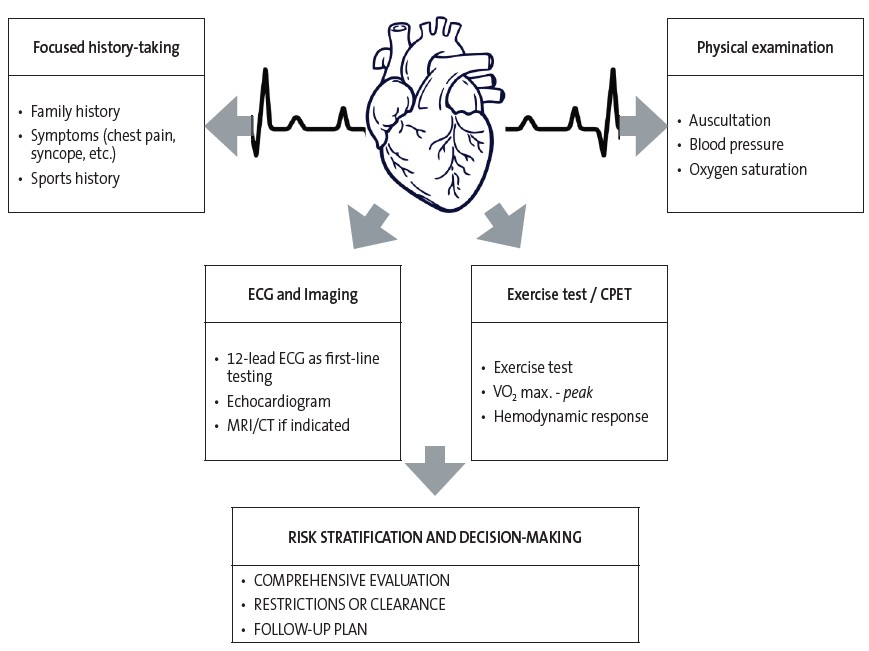
Assessing sports eligibility in children and adolescents with congenital heart disease is a fundamental component of their care, as it helps balance the promotion of physical activity and the prevention of potential exercise-related cardiovascular events. This process should not focus exclusively on identifying contraindications, but rather entails a comprehensive assessment of individual risk taking into account the hemodynamic impact of heart disease, functional capacity, the presence of arrhythmias, and the cardiovascular response to exercise. Figure 1 summarizes the main components of the sports eligibility evaluation.
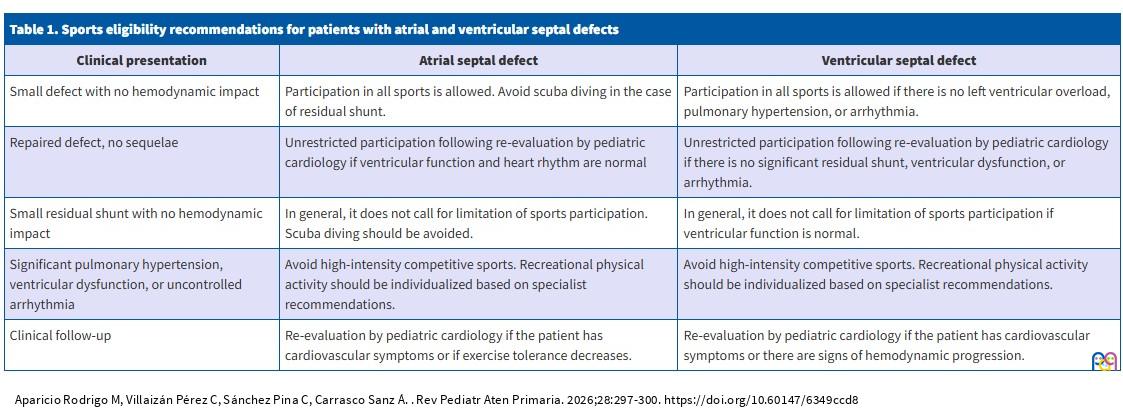
A systematic approach to sports eligibility or preparticipation screening facilitates individualized exercise prescribing, prevents unnecessary restrictions that foster sedentary lifestyle habits, and contributes to the physical, psychological, and social development of pediatric patients. The evaluation should focus on identifying the relevant clinical factors that allow safe participation in sports, thereby promoting healthy habits in the long term, in addition to optimizing clinical decision-making in patients with congenital heart disease. Table 1 summarizes the main aspects that should be considered in this process.
| Figure 1. Key components of the sports preparticipation evaluation in patients with congenital heart disease |
|---|
 |
| Table 1. Sports eligibility recommendations for patients with atrial and ventricular septal defects | ||
|---|---|---|
| Clinical presentation | Atrial septal defect | Ventricular septal defect |
| Small defect with no hemodynamic impact | Participation in all sports is allowed. Avoid scuba diving in the case of residual shunt. | Participation in all sports is allowed if there is no left ventricular overload, pulmonary hypertension, or arrhythmia. |
| Repaired defect, no sequelae | Unrestricted participation following re-evaluation by pediatric cardiology if ventricular function and heart rhythm are normal | Unrestricted participation following re-evaluation by pediatric cardiology if there is no significant residual shunt, ventricular dysfunction, or arrhythmia. |
| Small residual shunt with no hemodynamic impact | In general, it does not call for limitation of sports participation. Scuba diving should be avoided. | In general, it does not call for limitation of sports participation if ventricular function is normal. |
| Significant pulmonary hypertension, ventricular dysfunction, or uncontrolled arrhythmia | Avoid high-intensity competitive sports. Recreational physical activity should be individualized based on specialist recommendations. | Avoid high-intensity competitive sports. Recreational physical activity should be individualized based on specialist recommendations. |
| Clinical follow-up | Re-evaluation by pediatric cardiology if the patient has cardiovascular symptoms or if exercise tolerance decreases. | Re-evaluation by pediatric cardiology if the patient has cardiovascular symptoms or there are signs of hemodynamic progression. |
CONCLUSIONS
Atrial and ventricular septal defects are the most common congenital heart defects in children and adolescents and are a frequent reason for medical consultation in relation to physical activity and sports. The current evidence indicates that most children and adolescents with small ASDs or VSDs that have no significant hemodynamic impact can safely engage in physical activity and sports, including competitive sports in select cases, following an adequate clinical evaluation.
Sports eligibility should not be determined based on the anatomical diagnosis alone, but rather on a comprehensive evaluation that considers the size of the defect, the presence of pulmonary hypertension or arrhythmias, ventricular function, and, in operated patients, the clinical condition of the patient following the repair. This approach helps avoid unnecessary restrictions and promotes active lifestyles that have cardiovascular and functional benefits.
Preparticipation sports screening is a key tool for risk stratification and individualized exercise prescribing. The integration of a focused history-taking and physical examination and the information obtained from diagnostic tests performed during the follow-up by the pediatric cardiology team (including echocardiography and, in select cases, cardiopulmonary exercise testing) enables more accurate decision-making, especially in patients with septal defects of moderate severity, repaired defects, or potential sequelae.
The PC pediatrician plays a key role in the long-term follow-up of these patients, identifying warning signs or symptoms, providing initial guidance on physical activity, and helping coordinate care with the pediatric cardiology team when a specialized reevaluation is required. In cases of greater medical complexity, such as those presenting with significant pulmonary hypertension, ventricular dysfunction, or uncontrolled arrhythmias, competitive sports may be contraindicated, and physical activity should be individualized according to the patient's functional capacity and the recommendations of the specialist.
This coordinated approach based on individual risk stratification allows the promotion of safe physical activity and supports the holistic development of children and adolescents with congenital heart disease.
CONFLICTS OF INTEREST
The authors have no conflicts of interest to declare in relation to the preparation and publication of this article.
AUTHORSHIP
All authors have contributed equally to the preparation of the published manuscript.
ABBREVIATIONS
ASD: atrial septal defect · PC: primary care · VSD: ventricular septal defect.
REFERENCES
- Zeppilli P, Biffi A, Cammarano M, Castelletti S, Cavarretta E, Cecchi F, et al. Italian cardiological guidelines (COCIS) for competitive sport eligibility in athletes with heart disease: update 2024. Minerva Med. 2024;115(5):533-64. https://doi.org/10.23736/S0026-4806.24.09519-3
- Longo UG, Ahlbaumer G, Vannicelli R, Gregorace E, Ortolina D, Nicodemi G, et al. Italian guidelines for cardiological evaluation in competitive football players: a detailed review of COCIS protocols. Healthcare (Basel). 2025;13(15):1932. https://doi.org/10.3390/healthcare13151932
- Kim JH, Baggish AL, Emery MS, Martinez MW, Phelan D, Kim J, et al. Clinical considerations for competitive sports participation for athletes with cardiovascular abnormalities: a scientific statement from the American Heart Association and American College of Cardiology. Circulation. 2025;151(11):e716-e761. https://doi.org/10.1016/j.jacc.2024.12.025
- Curran T, Wong TC, Bradley EA, Zaidi AN, Gersony WM, Gurvitz MZ, et al. Exercise counseling in congenital heart disease: a guide for the pediatric and congenital cardiologist. Pediatr Cardiol. 2025;46:1-16. https://doi.org/10.1007/s00246-025-04085-z
- Egger F, Serner A, Wilke CF, Grimm K, Massey A, Meyer T, et al. Global cardiac screening practices among youth and adult football players: the FIFA cardiac screening survey. Br J Sports Med. 2025;59(20):1410-17. https://doi.org/10.1136/bjsports-2025-109949
- Karunanithi Z, Andersen MJ, Mellemkjær S, Alstrup M, Waziri F, Clemmensen TS, et al. Impaired left and right systolic ventricular capacity in corrected atrial septal defect patients. Int J Cardiovasc Imaging. 2022;38(6):1221-31. https://doi.org/10.1007/s10554-021-02506-7
- Van Genuchten WJ, Helbing WA, Ten Harkel ADJ, Fejzic Z, Slieker MG, Bartelds B, et al. Exercise capacity in children with congenital heart disease. Eur J Pediatr. 2023;182(1):295-306. https://doi.org/10.1007/s00431-022-04648-9
- Sjöberg P, Clausen H, Arheden H, Liuba P, Hedström E. Atrial septal defect closure in children at young age is beneficial for left ventricular function. Eur Heart J Imaging Methods Pract. 2024;2(1):qyae058. https://doi.org/10.1093/ehjimp/qyae058
- Świątkiewicz I, Bednarczyk Ł, Kasprzak M, Laskowska E, Woźnicki M. Effectiveness and safety of transcatheter atrial septal defect closure in adults with systemic hypertension. J Clin Med. 2022;11(4):973. https://doi.org/10.3390/jcm11040973
- Rao PS. Diagnosis and management of ventricular septal defects. Rev Cardiovasc Med. 2024;25(11):411. https://doi.org/10.31083/j.rcm2511411
- Mavroudis C, Backer CL, Anderson RH. Ventricular septal defect. In: Mavroudis C, Backer CL, editors. Pediatric cardiac surgery. 4th ed. Hoboken: Wiley-Blackwell; 2023. p. 317-360.
- Hill B, Grubic N, Williamson M, Phelan DM, Baggish AL, Dorian P, et al. Does cardiovascular preparticipation screening cause psychological distress in athletes? Br J Sports Med. 2023;57(3):172-178. https://doi.org/10.1136/bjsports-2022-105918
- Beach CM, Lampert R. Optimizing pre-participation screening to prevent tragedy in young athletes: moving from if to how. Eur Heart J. 2023;44(12):1093-95. https://doi.org/10.1093/eurheartj/ehad015
- Corrado D, Zorzi A, Sarto P. Pre-participation screening for safe sports activity. Eur Heart J. 2023;44(24):2258-59. https://doi.org/10.1093/eurheartj/ehad288
- Blank ZJ, Spicer RL, Robinson JA. Preparticipation state cardiac screening forms for athletes. Pediatrics. 2023;151(1):e2022056798. https://doi.org/10.1542/peds.2022-056798
- Takken T, Giardini A, Reybrouck T, Gewillig M, Hövels-Gürich HH, Longmuir PE, et al. Recommendations for physical activity, recreation sport, and exercise training in paediatric patients with congenital heart disease. Eur J Prev Cardiol. 2012;19(5):1034-65. https://doi.org/10.1177/1741826711420000
- Ubeda Tikkanen A, Vova J, Holman l, Chrisman M, Clarkson K, Santiago R, et al. Core components of a rehabilitation program in pediatric cardiac disease. Front Pediatr. 2023;11:1104794. https://doi.org/10.3389/fped.2023.1104794
- Valderrama P, Carugati R, Sardella A, Flórez S, de Carlos Back I, Fernández C, et al. Guía SIAC 2024 sobre rehabilitación cardiorrespiratoria en pacientes pediátricos con cardiopatías congénitas. Rev Esp Cardiol. 2024;77(8):680-9.
- Shibbani K, Abdulkarim A, Budts W, Roos-Hesselink J, Müller J, Shafer K, et al. Participation in competitive sports by patients with congenital heart disease: comparison of AHA/ACC and EAPC/ESC recommendations. J Am Coll Cardiol. 2024;83(7):772-82. https://doi.org/10.1016/j.jacc.2023.10.037
- Venna A, d’Udekem Y, Figueiredo S. Barriers and facilitators influencing physical activity in children with congenital heart disease: a rapid review. BMC Public Health. 2025;25(1):1180. https://doi.org/10.1186/s12889-025-22152-1
- Shah SS, Mohanty S, Karande T, Maheshwari S, Kulkarni S, Saxena A. Guidelines for physical activity in children with heart disease. Ann Pediatr Cardiol. 2022;15(5-6):467-88. https://doi.org/10.4103/apc.apc_73_22
- Sociedad Española de Cardiología Pediátrica y Cardiopatías Congénitas (SECPCC), Consejo Superior de Deportes (CSD). Guía clínica de evaluación cardiovascular previa a la práctica deportiva en pediatría. Madrid: Consejo Superior de Deportes; 2019.
- Díaz-González l, De la Guía-Galipienso F, Carro A, Sanz-de la Garza M, Madaria Z, Serratosa l, et al. Cribado cardiológico preparticipativo en deportistas recreativos, competitivos y de alto nivel en diferentes grupos de edad. REC: CardioClinics. 2024;59(3):225-34. https://doi.org/10.1016/j.rccl.2024.03.003
- Sitges M, Rincón JA, Brugada J, Matas RB, Vives MB, Cuixart DB, et al. Consenso para prevenir la muerte súbita cardíaca de los deportistas. Apunts: Medicina de l'esport. 2013;48(177):35-41.