





Vol. 28 - Num. 110
Originales
Aislamiento social: factor de riesgo para alteraciones del lenguaje en niños de 4 años
Alba B Vazquez Avila a, Roxana G. Cervantes Becerrab, Enrique Villarreal Ríosc, Liliana Galicia Rodríguezc
aResidente Medicina Familiar. Unidad de Medicina Familiar N.º 15 Querétaro. Instituto Mexicano del Seguro Social. Santiago de Querétaro. México.
bMedicina Familiar. Unidad de Medina Familiar N.º 11 Querétaro. Instituto Mexicano del Seguro Social. Santiago de Querétaro. México.
cUnidad de Investigación Epidemiológica y en Servicios de Salud Querétaro. Instituto Mexicano del Seguro Social. Santiago de Querétaro. México.
Correspondencia: L Galicia. Correo electrónico: lilianagalicia@hotmail.com
Cómo citar este artículo: Vazquez Avila AB, Cervantes Becerra RG, Villarreal Ríos E, Galicia Rodríguez L. Aislamiento social: factor de riesgo para alteraciones del lenguaje en niños de 4 años . Rev Pediatr Aten Primaria. 2026;28:171-8. https://doi.org/10.60147/11add993
Publicado en Internet: 10-04-2026 - Número de visitas: 5268
Resumen
Introducción: el aislamiento social es un factor ambiental potencialmente negativo sobre el desarrollo del lenguaje; este es un proceso dinámico de interacción neurobiológica, psicosocial y ambiental del niño.
Objetivo: determinar el aislamiento social como factor de riesgo para alteraciones del lenguaje en niños de 4 años.
Material y métodos: diseño cuasi experimental natural en niños de 4 años. Grupo no expuesto: niños de 4 años evaluados en 2018. Grupo expuesto: niños de 4 años en 2025 que estuvieron expuestos al aislamiento social durante 3 años. En ambos grupos se realizó la prueba de Evaluación del Desarrollo Infantil (EDI). Tamaño de la muestra de 87 niños antes del aislamiento y 62 niños después del aislamiento. Se estudió la edad de la madre y la alteración del lenguaje se clasificó con normal o rezago con la prueba EDI; se realizó un modelo de regresión logística múltiple.
Resultados: cuando la edad de la madre es 29 años y no existe aislamiento social la probabilidad de alteración del lenguaje en el niño de 4 años es 24,5% y si el aislamiento social está presente, la probabilidad de alteración del lenguaje se modifica a 79,6%.
Conclusión: en nuestra muestra, el aislamiento social y la edad materna son factores de riesgo para la alteración del lenguaje en niños de 4 años.
Palabras clave
● Aislamiento social ● Edad materna ● Lenguaje infantilINTRODUCCIÓN
El aislamiento social como política de salud se ve instaurado en algunos eventos de magnitud nacional o internacional como medida de protección ante fenómenos naturales, como las epidemias. En concreto, en México ese evento se instauró del año 2020 al 2023. Dichas medidas incluían el uso de mascarillas, la limitación de la interacción fuera del núcleo familiar, el cierre de centros educativos y de espacios de socialización. El aislamiento social es tomado como un factor ambiental potencialmente negativo sobre el desarrollo del lenguaje al limitar las oportunidades de interacción verbal, el juego social y la exposición a modelos lingüísticos diversos1-4.
El desarrollo del lenguaje durante la infancia es un proceso dinámico y de múltiples factores. En él se relaciona la interacción neurobiológica, psicosocial y ambiental del niño. La adquisición y consolidación del lenguaje involucra la maduración del sistema nervioso central, a la par que la exposición a una variedad lingüística que se obtiene por las interacciones sociales con cuidadores e iguales. Se ha estudiado que la interacción social frecuente y de calidad constituye un factor clave para el desarrollo lingüístico temprano, potenciando la exposición verbal, la comprensión pragmática y la retroalimentación responsiva5-9.
La prueba de Evaluación del Desarrollo Infantil (EDI) ha sido desarrollada y validada como una herramienta de screening para identificar retrasos en el desarrollo del niño desde un mes de edad hasta los 5 años y 11 meses. La prueba comprende el dominio de las siguientes capacidades: lenguaje, motricidad fina, motricidad gruesa, interacción social, conocimiento adaptativo, exploración neurológica, factores de riesgo biológico, señales de alerta y también señales de alarma. Permite clasificar a los niños en niveles de desarrollo normal, rezago o riesgo de retraso, facilitando la intervención temprana y la derivación oportuna a los servicios especializados. Sin embargo, debemos enfatizar que no se trata de una herramienta de diagnóstico. Identificar de forma temprana las alteraciones del neurodesarrollo en la infancia es un eje central de la medicina familiar y la atención en primer nivel, por su impacto inmediato y a largo plazo sobre la salud, la educación y la integración social de los individuos10.
Se ha documentado que, a mayor exposición a condiciones de aislamiento social, existe una disminución en las habilidades del lenguaje receptivo y expresivo en preescolares. Aunado a ello, existen cambios permanentes en el neurodesarrollo, encendiendo así alarmas en la salud pública. El lenguaje no es solo fundamental para la comunicación, sino que también se relaciona con el campo académico, la regulación emocional y la integración social a lo largo de la vida. La prevalencia de alteración del lenguaje en prescolares es del 15%11-16.
Ante este panorama, el objetivo del estudio es determinar el aislamiento social como factor de riesgo para alteraciones del lenguaje en niños de 4 años.
MATERIAL Y MÉTODOS
Diseño cuasi experimental natural en niños de 4 años de una institución de la seguridad social de la ciudad de Querétaro, México, del año 2018 al año 2025.
La intervención consintió en medidas de aislamiento social normadas como políticas de salud pública del 2020 al 2023. Las acciones incluyeron: confinamiento domiciliario, uso de mascarillas de manera constante dentro y fuera del hogar, suspensión de las actividades grupales y de la asistencia a preescolar, escolar, niveles de educación media y superior; suspensión de las actividades recreativas, las reuniones familiares, de amigos y de grupos religiosos; limitación de la actividad social, la asistencia a parques públicos, cines, centros comerciales y restaurantes; cuando la convivencia existió, se estableció la distancia de 1,5 metros entre personas.
Se consideró como grupo control a niños de 4 años antes del inicio del confinamiento en los cuales se aplicó la prueba EDI. El grupo expuesto lo integraron niños nacidos en el 2020-2021 que estuvieron expuestos al aislamiento social durante 3 años y que, al momento de la encuesta, contaban con 4 años de edad. Se incluyeron niños de 4 años de la misma comunidad, que el tutor aceptara la participación del menor y que estuvieran dispuestos a contestar la prueba EDI. Se excluyeron niños diferentes a la comunidad señalada, aquellos con diagnóstico previo de alteración del neurodesarrollo (autismo, TDAH subtipo tanto hiperactivo como inatento o combinado), síndrome de Down, diagnóstico de discapacidad neurosensorial, discapacidad intelectual, antecedente de traumatismo craneoencefálico, antecedente de asfixia perinatal, antecedente de prematuridad y antecedente familiar de alteraciones del lenguaje.
El tamaño de la muestra se calculó con la fórmula para diseño cuasi experimental con nivel de confianza del 95% para una zona de rechazo de la hipótesis nula (Zalfa = 1,64), poder de prueba del 80% (Zbeta = 0,84), asumiendo que en el grupo control (antes del aislamiento social) la prevalencia de alteración del lenguaje era 15% (p0 = 0,15) y en el grupo de intervención (después del aislamiento social) la prevalencia de alteración del lenguaje era 35% (p1 = 0,35). El tamaño de la muestra calculado fue de 57 por grupo; no obstante, se trabajó con 87 niños antes del aislamiento y 62 niños después del aislamiento.
Para el grupo control se incluyeron todos los niños a los que se les había aplicado la prueba EDI y que estaban registrados en la base de datos. Para el grupo de intervención, la técnica muestral fue no aleatoria por casos consecutivos, utilizando como marco muestral los niños que asistieron a la unidad de salud.
Las variables estudiadas del niño incluyeron sexo, escolaridad y presencia o no de hermanos. Se estudió también la edad de la madre.
Para la alteración del lenguaje se utilizó la prueba EDI en la dimisión del lenguaje específica para el grupo 13 (37 meses a 48 meses con 29 días de edad). La prueba fue aplicada por un solo investigador que recibió capacitación y estandarización previa.
El plan de análisis estadístico incluyó porcentajes, promedios, prueba de chi cuadrada, riesgo relativo, intervalo de confianza para riesgo relativo, prueba de T, regresión logística múltiple y cálculo de la probabilidad de ocurrencia del evento.
El protocolo se registró ante el Comité Investigación y Ética de la institución de seguridad social con el número de registro institucional R-2024-2201-219. En todos los casos se contó con carta de consentimiento informado y bajo los criterios de Helsinki.
RESULTADOS
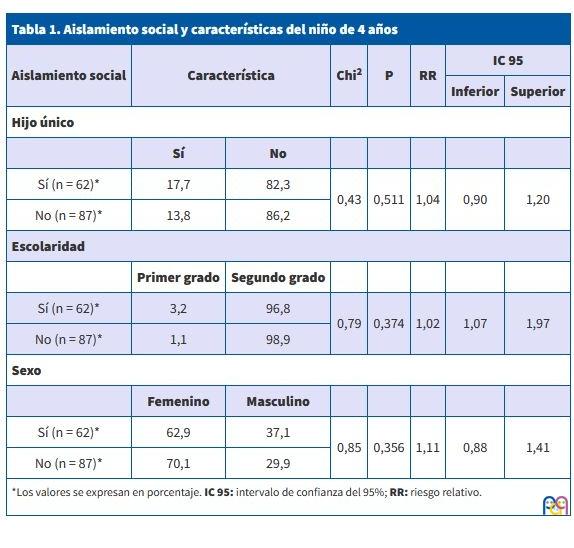
En el niño con aislamiento social, la prevalencia del sexo femenino es 62,9% y en el niño sin aislamiento social la prevalencia del sexo femenino es 70,1% (p = 0,356). Las variables escolaridad (p = 0,374) y primer hijo (p = 0,511) también permitieron comparar ambos grupos, al no ser estadísticamente significativas sus diferencias (Tabla 1).
| Tabla 1. Aislamiento social y características del niño de 4 años | |||||||
|---|---|---|---|---|---|---|---|
| Aislamiento social | Característica | Chi2 | P | RR | IC 95 | ||
| Inferior | Superior | ||||||
| Hijo único | |||||||
| Sí | No | ||||||
| Sí (n = 62)* | 17,7 | 82,3 | 0,43 | 0,511 | 1,04 | 0,90 | 1,20 |
| No (n = 87)* | 13,8 | 86,2 | |||||
| Escolaridad | |||||||
| Primer grado | Segundo grado | ||||||
| Sí (n = 62)* | 3,2 | 96,8 | 0,79 | 0,374 | 1,02 | 1,07 | 1,97 |
| No (n = 87)* | 1,1 | 98,9 | |||||
| Sexo | |||||||
| Femenino | Masculino | ||||||
| Sí (n = 62)* | 62,9 | 37,1 | 0,85 | 0,356 | 1,11 | 0,88 | 1,41 |
| No (n = 87)* | 70,1 | 29,9 | |||||
|
*Los valores se expresan en porcentaje. IC 95: intervalo de confianza del 95%; RR: riesgo relativo. |
|||||||
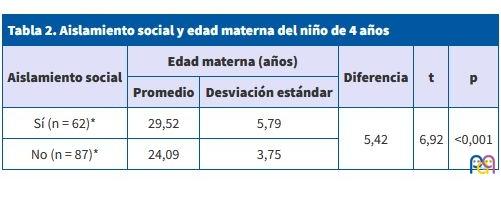
La edad materna estadísticamente fue superior (p <0,001) en los niños con aislamiento social: en este grupo, la edad materna fue 29,52 años y en el grupo sin aislamiento social fue 24,09 años (Tabla 2).
| Tabla 2. Aislamiento social y edad materna del niño de 4 años | |||||
|---|---|---|---|---|---|
| Aislamiento social | Edad materna (años) | Diferencia | t | p | |
| Promedio | Desviación estándar | ||||
| Sí (n = 62) | 29,52 | 5,79 | 5,42 | 6,92 | <0,001 |
| No (n = 87) | 24,09 | 3,75 | |||
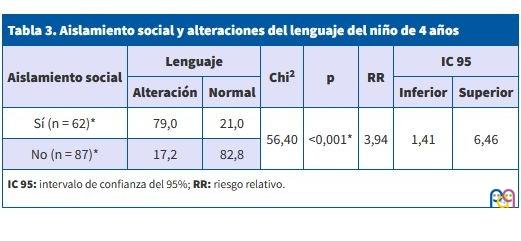
En el grupo con aislamiento social la alteración del lenguaje se presentó en el 97,0% de los niños y en el grupo sin aislamiento social la prevalencia fue 17,2%, valores estadísticamente significativos (p <0,001) (Tabla 3).
| Tabla 3. Aislamiento social y alteraciones del lenguaje del niño de 4 años | |||||||
|---|---|---|---|---|---|---|---|
| Aislamiento social | Lenguaje | Chi2 | p | RR | IC 95 | ||
| Alteración | Normal | Inferior | Superior | ||||
| Sí (n = 62)* | 79,0 | 21,0 | 56,40 | <0,001 | 3,94 | 1,41 | 6,46 |
| No (n = 87)* | 17,2 | 82,8 | |||||
|
IC 95: intervalo de confianza del 95%; RR: riesgo relativo. |
|||||||
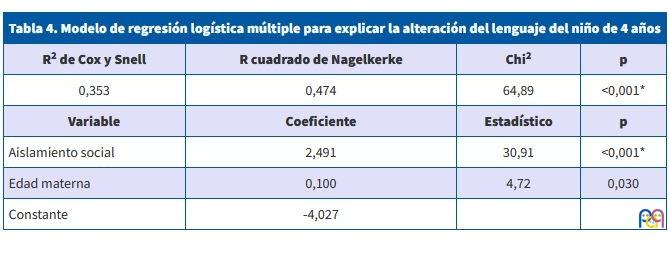
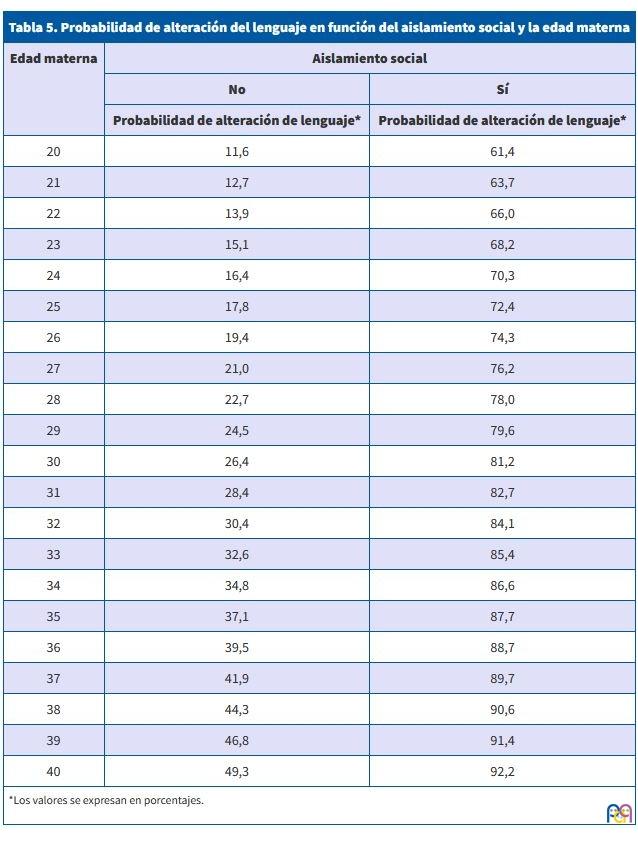
La ecuación de regresión múltiple para explicar la alteración del lenguaje incluyó aislamiento social y edad materna y = -4,027+2,491 (aislamiento social) +0,100 (edad materna). En la Tabla 4 se presenta la información. Cuando la edad de la madre es 29 años y no existe aislamiento social la probabilidad de alteración del lenguaje en el niño de 4 años es 24,5%, y si el aislamiento social está presente, la probabilidad de alteración del lenguaje se modifica a 79,6%. Cuando la edad materna es 35 años y no existe aislamiento social, la probabilidad de alteración del lenguaje es 37,1% y se modifica a 87,7% cuando existe aislamiento social. En la Tabla 5 se presenta la probabilidad para diferentes escenarios.
| Tabla 4. Modelo de regresión logística múltiple para explicar la alteración del lenguaje del niño de 4 años | |||
|---|---|---|---|
| R2 de Cox y Snell | R cuadrado de Nagelkerke | Chi2 | p |
| 0,353 | 0,474 | 64,89 | <0,001 |
| Variable | Coeficiente | Estadístico | p |
| Aislamiento social | 2,491 | 30,91 | <0,001 |
| Edad materna | 0,100 | 4,72 | 0,030 |
| Constante | -4,027 | ||
| Tabla 5. Probabilidad de alteración del lenguaje en función del aislamiento social y la edad materna | ||
|---|---|---|
| Edad materna | Aislamiento social | |
| No | Sí | |
| Probabilidad de alteración de lenguaje* | Probabilidad de alteración de lenguaje* | |
| 20 | 11,6 | 61,4 |
| 21 | 12,7 | 63,7 |
| 22 | 13,9 | 66,0 |
| 23 | 15,1 | 68,2 |
| 24 | 16,4 | 70,3 |
| 25 | 17,8 | 72,4 |
| 26 | 19,4 | 74,3 |
| 27 | 21,0 | 76,2 |
| 28 | 22,7 | 78,0 |
| 29 | 24,5 | 79,6 |
| 30 | 26,4 | 81,2 |
| 31 | 28,4 | 82,7 |
| 32 | 30,4 | 84,1 |
| 33 | 32,6 | 85,4 |
| 34 | 34,8 | 86,6 |
| 35 | 37,1 | 87,7 |
| 36 | 39,5 | 88,7 |
| 37 | 41,9 | 89,7 |
| 38 | 44,3 | 90,6 |
| 39 | 46,8 | 91,4 |
| 40 | 49,3 | 92,2 |
|
*Los valores se expresan en porcentajes. |
||
DISCUSIÓN
Las medidas de aislamiento social instauradas como parte de una política de salud fue algo temporal y no planificado que permitió estudiar los efectos de la disminución de la interacción social sobre distintos dominios del desarrollo infantil, sin asignación aleatoria deliberada a la exposición. El estudio de las barreras de comunicación es importante para aportar evidencia en el contexto de Atención Primaria y en un ámbito en el que aún existe escasez de investigaciones sobre el impacto del aislamiento social en el desarrollo del lenguaje.
En este contexto, el diseño cuasi experimental natural de nuestro estudio, que se caracteriza por la evaluación de exposiciones que ocurren de manera independiente a la voluntad del investigador, y dadas por un agente exógeno que puede ser una ley, una política sectorial o un fenómeno natural, permite la comparación entre grupos expuestos y no expuestos. Ello predice los efectos de la exposición, favoreciendo la evaluación de asociaciones en grupos poblacionales, y contribuye a una adecuada validez externa. Este modelo resulta apropiado para el análisis de determinantes sociales, en este caso del desarrollo infantil17,18.
La evaluación del riesgo lingüístico en niños, además de las variables clínicas y demográficas tradicionales, también debe incluir los determinantes sociales y el entorno inmediato, específicamente el tiempo de interacción social del niño, la calidad de la estimulación familiar y el tiempo de exposición a pantallas, escenario que podría considerarse como una limitación de la investigación19.
Un factor de riesgo para la alteración del lenguaje en el preescolar identificado en nuestra muestra fue la edad materna: a mayor edad, mayor probabilidad de alteración del lenguaje (p <0,001*). Estos datos son relevantes puesto que, en la actualidad, la postergación de la maternidad es cada vez mayor, la edad para el primer embarazo fluctúa entre 30 y 31 años, información que coincide con el promedio de edad encontrada en este trabajo, lo cual refuerza la validez de estos datos. La relación entre desarrollo infantil y edad materna identifica determinantes sociales y conductuales, ya que a mayor edad materna cambia la experiencia en diferentes tipos de modelos de crianza. Siempre y cuando no sea el primer hijo, estarán presentes las redes de apoyo y mayor experiencia en prácticas de estimulación del lenguaje, pero a su vez también estas madres pueden coexistir con mayores responsabilidades laborales, lo que lleva a un menor tiempo de interacción cara a cara con el niño. Se ha señalado una relación no lineal entre la edad materna y los resultados de desarrollo lingüístico, identificando que los niños de madres en un rango intermedio de edad tienden a presentar mejores perfiles de lenguaje, condición atribuible a la combinación de experiencia, estabilidad emocional y mejores condiciones socioeconómicas20-22.
El contexto social en el que se desenvuelven las madres jóvenes incluye mayores redes de apoyo u oportunidades de interacción familiar y comunitaria, condición que reduce el aislamiento social en sus hijos; mientras que las madres de mayor edad, con horarios más exigentes, mayor carga familiar o menor involucramiento comunitario, favorecen la menor exposición social para los niños23.
Los resultados señalan que el aislamiento social es un factor de riesgo para las alteraciones del lenguaje en niños de edad preescolar, lo cual es coherente con lo recogido en la evidencia científica. Específicamente, el distanciamiento, el cierre de los centros educativos y la limitación de la interacción cara a cara durante un periodo de 3 años se asociaron con trastorno del lenguaje basado en la falta de formación de redes neuronales, falta de exposición de diversos modelos lingüísticos y falta de retroalimentación pragmática natural, al no poder realizar la imitación activa de la mímica y las gesticulaciones, condición limitada por uso constante de mascarillas24-26.
El desarrollo del lenguaje durante la infancia temprana depende de procesos neurobiológicos claves, entre ellos la mielinización y las redes de lenguaje en regiones frontotemporales, específicamente, las áreas de Broca y Wernicke, el refuerzo sináptico mediado por experiencias ambientales ricas y repetitivas, la plasticidad cognitiva elevada en el periodo crítico de 2 a 5 años. De igual forma, se han identificado los factores sociales como los más influyentes durante esta etapa. La estimulación social provee patrones estructurados de entrada lingüística, entonación, turnos de habla y ampliación de vocabulario que refuerzan redes neuronales del lenguaje. Así, el aislamiento social limita las interacciones ricas en dialogo fluido, lo que se traduce en una disminución de estímulos lingüísticos, menor activación de circuitos neuronales relacionados con el procesamiento del habla y menor consolidación de reglas gramaticales y pragmáticas27-33.
El análisis múltiple expuesto ofrece una visión más integral de la alteración del lenguaje y se sugiere que el aislamiento social y la mayor edad materna podrían estar asociadas con la alteración del desarrollo del lenguaje en niños en edad preescolar.
CONCLUSIONES
El aislamiento social y la mayor edad materna podrían ser factores de riesgo para la alteración del lenguaje en niños de 4 años.
CONFLICTO DE INTERESES
Los autores declaran no presentar conflictos de intereses en relación con la preparación y publicación de este artículo.
RESPONSABILIDAD DE LOS AUTORES
Todos los autores han contribuido de forma equivalente en la elaboración del manuscrito publicado.
ABREVIATURAS
EDI: Evaluación del Desarrollo Infantil.
BIBLIOGRAFÍA
- Cabrera NJ, Moon UJ, Fagan J, West J, Aldoney D. Cognitive stimulation at home and in child care and children’s preacademic skills in two-parent families. Child Dev. 2020;91(5):1709-17. https://doi.org/10.1111/cdev.13380
- Donnellan E, Bannard C, McGillion ML, Slocombe KE, Matthews D. Infants’ intentionally communicative vocalizations elicit responses from caregivers and predict the transition to language. Dev Sci. 2020;23:e12843. https://doi.org/10.1111/desc.12843
- Mani N, Plunkett K. Phonological priming and cohort effects in toddlers. Cognition. 2011;121(2):196-206. https://doi.org/10.1016/j.cognition.2011.06.013
- Donnelly S, Kidd E. The longitudinal relationship between conversational turn-taking and vocabulary growth in early language development. Child Dev. 2021;92(2):609-25. https://doi.org/10.1111/cdev.13511
- Golinkoff RM, Hoff E, Rowe ML, Tamis-LeMonda CS, Hirsh-Pasek K. Language matters: denying the existence of the 30-million-word gap has serious consequences. Child Dev. 2019;90(3):985-92. https://doi.org/10.1111/cdev.13128
- Anderson NJ, Graham SA, Prime H, Jenkins JM, Madigan S. Linking quality and quantity of parental linguistic input to child language skills: a meta-analysis. Child Dev. 2021;92(2):484-501. https://doi.org/10.1111/cdev.13508
- Rowe ML, Snow CE. Analyzing input quality along three dimensions: interactive, linguistic, and conceptual. J Child Lang. 2020;47(1):5-21. https://doi.org/10.1017/S0305000919000655
- Boerma T, ter Haar S, Ganga R. What risk factors for developmental language disorder can tell us about the neurobiological mechanisms of language development. Neurosci Biobehav Rev. 2023;154:105398. https://doi.org/10.1016/j.neubiorev.2023.105398
- Hessami K, Norooznezhad AH, Monteiro S. COVID-19 pandemic and infant neurodevelopmental impairment: a systematic review and meta-analysis. JAMA Netw Open. 2022;5(10):e2238941. https://doi.org/10.1001/jamanetworkopen.2022.38941
- Centro Nacional para la Salud de la Infancia y Adolescencia (CeNSIA). Manual para la aplicación de la prueba EDI [en línea] [consultado el 27/01/2026]. Disponible en www.gob.mx/salud/censia/articulos/manual-para-la-aplicacion-de-la-prueba-edi/
- Pejovic J, Severino C, Vigário M, Frota S. Prolonged COVID-19-related effects on early language development: a longitudinal study. Early Hum Dev. 2024;195:106081. https://doi.org/10.1016/j.earlhumdev.2024.106081
- Feijoo S, Amadó A, Sidera F, Aguilar-Mediavilla E, Serrat E. Language acquisition in a post-pandemic context: impact of COVID-19 measures on early language development. Front Psychol. 2023;14:1205294. https://doi.org/10.3389/fpsyg.2023.1205294
- Lee CS, Hwang S. Association between COVID-19 exposure duration on receptive and expressive language development in preschool children. Children (Basel). 2025;12(12):1637. https://doi.org/10.3390/children12121637
- Kyvrakidou E, Kyvrakidis G, Stefanaki AS. The impact of COVID-19 on the language skills of preschool children: data from a school screening project in Greece. Children (Basel). 2025;12(3):376. https://doi.org/10.3390/children12030376
- Cassinat JR, Whiteman SD, Serang S. Changes in family chaos and family relationships during the COVID-19 pandemic. Dev Psychol. 2021;57(10):1597-1610. https://doi.org/10.1037/dev0001217
- Cristia A, Lavechin M, Scaff C. A thorough evaluation of the Language ENvironment Analysis (LENA) system. Behav Res Methods. 2021;53:467-86. https://doi.org/10.3758/s13428-020-01393-5
- Göppert F, Bhatia K, Meyen S, Franz VH. Realistic expectations for replications: expecting too little is as bad as expecting too much. Adv Methods Pract Psychol Sci. 2025;8(3):1-8. https://doi.org/10.1177/25152459251369846
- Nass Kunstmann L, Merino JM. El experimento natural como un nuevo diseño cuasi-experimental en investigación social y de salud [en línea] [consultado el 27/01/2026]. Disponible en www.scielo.cl/scielo.php?script=sci_arttext&pid=s0717-95532008000200002&lng=es
- Weng W, Liu M, Wang S. The impact of lockdown on child adjustment: a propensity score matched análisis. BMC Psychol. 2024;12:409. https://doi.org/10.1186/s40359-024-01894-4
- Şengül-İnal G, Borgen NT, Skopek J, Nærde A, Zachrisson HD. Maternal education, early language skills, and mother-child interactions across three welfare states. J Marriage Fam. 2025;87(4):1549-70. https://doi.org/10.1111/jomf.13087
- Madigan S, Plamondon A, Jenkins JM. Association between maternal sensitivity and infant receptive language development: quasi-causal evidence using a sibling-comparison design. Dev Psychol. 2023;59(12):2265-76. https://doi.org/10.1037/dev0001604
- Ahmad M, Sechi C, Vismara L. Advanced maternal age: an exploratory review of psychological impact on mothers, infants, and their relationship. Behav Sci (Basel). 2024;14(3):147. https://doi.org/10.3390/bs14030147
- Falster K, Hanly M, Banks E. Maternal age and offspring developmental vulnerability at age five: a population-based cohort study. PLoS Med. 2018;15(4):e1002558. https://doi.org/10.1371/journal.pmed.1002558
- Singh L, Tan A, Quinn PC. Infants recognize words spoken through opaque masks but not through transparent masks. Dev Sci. 2021;24:e13117. https://doi.org/10.1111/desc.13117
- Chen Y, Cabrera NJ, Reich SM. Mother–child and father–child serve-and-return interactions at 9 months: associations with children’s language skills at 18 and 24 months. Infant Behav Dev. 2023;73:101894. https://doi.org/10.1016/j.infbeh.2023.101894
- Lalonde K, Buss E, Miller MK, Leibold LJ. Face masks impact auditory and audiovisual consonant recognition in children with and without hearing loss. Front Psychol. 2022;13:874345. https://doi.org/10.3389/fpsyg.2022.874345
- Frausel RR, Richland LE, Levine SC, Goldin-Meadow S. Personal narrative as a breeding ground for higher-order thinking talk in early parent–child interactions. Dev Psychol. 2021;57(4):519-34. https://doi.org/10.1037/dev0001166
- Winstone LK, Benitez VL, van Huisstede L. Patterns of maternal interactive behaviors and dual vocabulary development in Mexican American children. Dev Psychol. 2021;57(11):1866-79. https://doi.org/10.1037/dev0001024
- Donnelly S, Kidd E. Individual differences in lexical processing efficiency and vocabulary in toddlers: a longitudinal investigation. J Exp Child Psychol. 2020;192:104781. https://doi.org/10.1016/j.jecp.2019.104781
- Kidd E, Donnelly S, Christiansen MH. Individual differences in language acquisition and processing. Trends Cogn Sci. 2018;22(2):154-69. https://doi.org/10.1016/j.tics.2017.11.006
- Kuhl PK. Is speech learning gated by the social brain? Dev Sci. 2007;10:110-20. https://doi.org/10.1111/j.1467-7687.2007.00572.x
- Kidd E, Donnelly S. Individual differences in first language acquisition. Annu Rev Linguist. 2020;6:319-40. https://doi.org/10.1146/annurev-linguistics-011619-030326
- Borovsky A. Lexical–semantic structure of vocabulary and its relation to lexical processing in early childhood and language outcomes at age three. Dev Psychol. 2022;58(4):607-30. https://doi.org/10.1037/dev0001291