




Número actual
Suplemento

.png)






 RSS
RSSVol. 26
Enero/Marzo 2024
Núm. 101
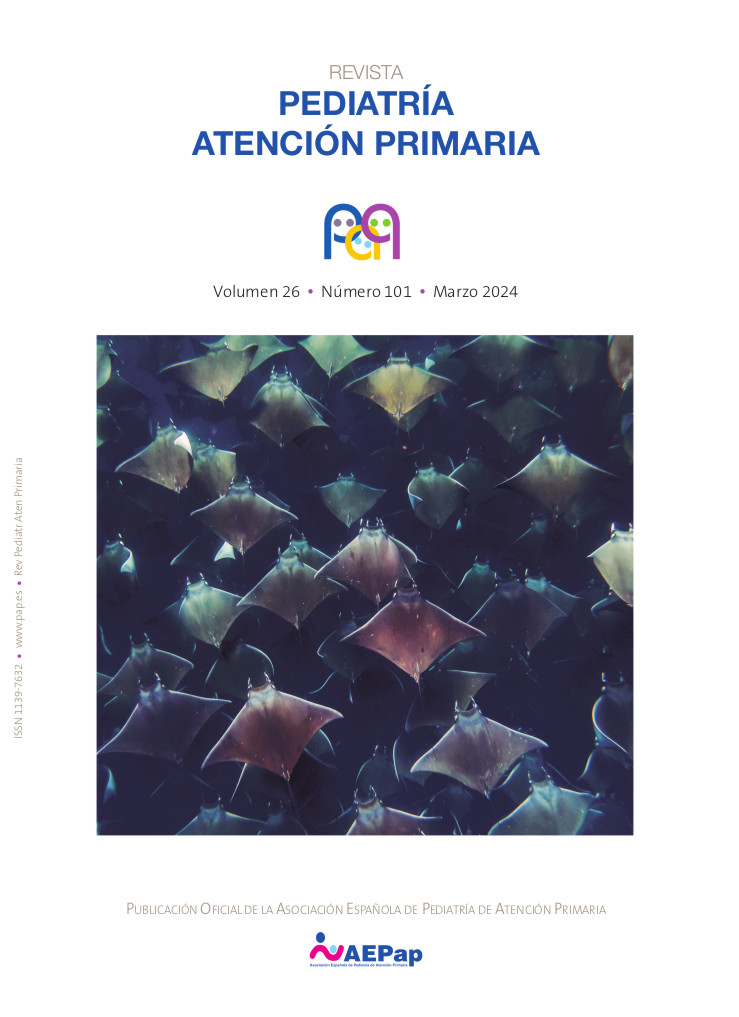
Imagen de portada
Editorial
Originales
- Efectividad de la formación teórico-práctica en soporte vital básico a monitoras de comedores escolares desde Atención Primaria . Gustavo Andrés Salom Osta, Natalia Campos Uribe
- Entrevista motivacional como estrategia de mejoramiento de la salud bucal de niños y cuidadores. Revisión en sombrilla . Ana M.ª Horta Maya, Luisa Fernanda Gutiérrez Gutiérrez, Cecilia M.ª Martínez Delgado, Daniel Demetrio Faustino Silva, M.ª del Carmen Villanueva Vilchis, M.ª de los Ángeles Ramírez Trujillo, Ricardo Cartés Velásquez
- Melatonina en trastornos del sueño: comparación de distintos productos y revisión bibliográfica . Victoria Domínguez León, Beatriz Flores Méndez, Cristóbal Coronel Rodríguez
- Adecuación de las prescripciones médicas en faringitis estreptocócicas y otitis media aguda a las guías terapéuticas . Marcelo Vivas Moresco, Beatriz Barbarin Sorozabal, Silvia García de Garayo Díaz, José Tomás Ramos Amador
- Crecimiento y desarrollo puberal en niñas adoptadas de Rusia: seguimiento de 12 años . Gonzalo Oliván Gonzalvo
Notas clínicas
- Síndrome de Alicia en el País de las Maravillas secundario a infección por SARS-CoV-2 . Sara Beltrán García, Eva M.ª Jiménez Pérez, Paula Vidal Lana, M.ª Pilar Vicente Gutiérrez, Mercedes Cemeli Cano
- Erección prolongada dolorosa . María Abad Cortés, Carlos Marcilla Vázquez, María Ramírez Piqueras, Ana López Villanueva, Osane Romero Pardo, Andrea Espada García
- Malformación de Arnold Chiari . M.ª Tatiana Fernández Garrido, Jorge Lévano Vásquez, M.ª Mercedes Santos Herrero, Jesús M.ª Pascual Pérez, Anny Vanessa Martínez Báez
- Parálisis facial, la importancia de realizar una buena historia clínica . Alicia Gaitero Pérez, Carmen Martínez del Río, Paula Cabrera Cascajero, Marta Illán Ramos, Arantxa Berzosa Sánchez, José Tomás Ramos Amador
- Absceso mamario neonatal . Victoria Domínguez León, M.ª del Mar Estepa Jiménez, Estela Membrillo Contioso, Cristóbal Coronel Rodríguez
- Viruela símica: reporte de un caso clínico . Matxil Violeta Díaz Benavides , Juan Daniel López Rocha
- Bronquiolitis obliterante posinfecciosa secundaria a adenovirus . Sara Beltrán García, Elena Aranda Conchello, Carlos Martín de Vicente, Mercedes Odriozola Grijalba, Mercedes Cemeli Cano
Casos clínicos en Digestivo
Revisiones
- Fallo de medro en Pediatría de Atención Primaria: recomendaciones para su abordaje y seguimiento . M.ª Cristina de Hoyos López, José Pelayo León Jiménez, Nuria Puente Ubierna, Alberto Barasoain Millán, Carolina Bezanilla López, Gonzalo Botija Arcos, M.ª Mercedes Bueno Campaña, Manuela Martínez Campos, Aránzazu Recio Linares
Grupo Vías Respiratorias
Pediatría Basada en la Evidencia
Colaboraciones especiales
- ¡Hasta luego, amigos! . Concepción Sánchez Pina, M.ª Dolores Cantarero Vallejo, Carmen Villaizán Pérez, Pedro J. Gorrotxategi Gorrotxategi, M.ª Teresa Cenarro Guerrero, Eva Suárez Vicent, Marianna Mambié Meléndez, Narcisa Palomino Urda, Carmen Rosa Rodríguez Fernández-Oliva, César García Vera
- Pintar y aprender a vivir sano . Irene Estrada Lázaro, María Vázquez Sánchez, Carmen Villanueva Rodríguez, José Galbe Sánchez-Ventura, Pilar Sierra Sanmartín, Andrea de Llobet Cucalón
A la Pediatría desde el Arte
Cartas al director
Leído. Libros, revistas e Internet
- PROA. Apostando por una utilización responsable de los antibióticos .
- Hablemos de salud afectivo-sexual y pornografía con los adolescentes: una guía para familias .
- Aventuras de un médico rural en Irlanda .
- No todo es clínica .
- Barreras y facilitadores de la actividad física en la infancia .
- El Instituto-Escuela y la Institución Libre de Enseñanza .
Imágenes de los lectores
Video 25 años Revista Pediatría de Atención Primaria
 Suscríbete al boletín de novedades
ENLACES